

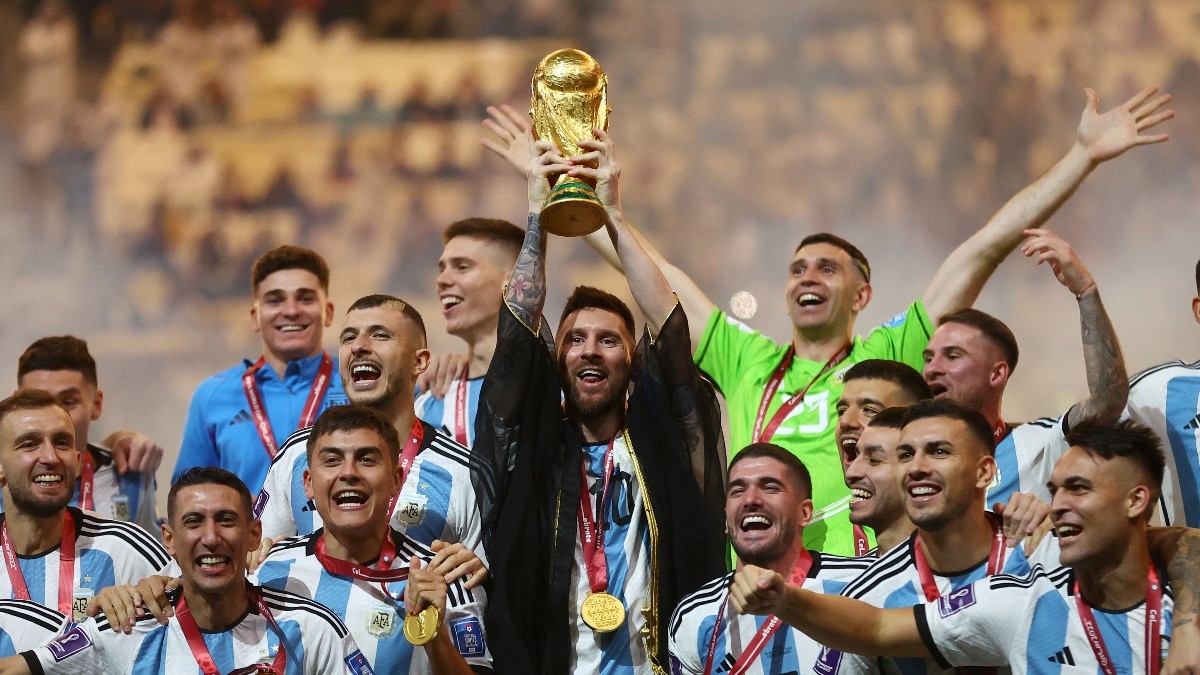
With barely weeks left before the FIFA World Cup 2026 kicks off on June 12, Indian football fans still do not know where they will be able to watch the tournament. And now, public broadcaster Prasar Bharati has officially distanced itself from the ongoing broadcasting uncertainty, telling the Delhi High Court that it is “not responsible” for acquiring FIFA World Cup rights in India.
The submissions were made before Justice Purushaindra Kumar Kaurav during the hearing of a petition seeking directions to ensure the FIFA World Cup 2026 is broadcast in India through public broadcaster Prasar Bharati. The plea had specifically pushed for free-to-air telecast of key matches, including the opening game, quarter-finals, semi-finals and the final through platforms like Doordarshan and DD Sports.
The matter took another twist on May 19 after petitioner Advocate Avdhesh Bairwa sought permission to withdraw the petition with liberty to approach another competent court for appropriate relief.
The Delhi High Court had earlier issued notice to the Ministry of Information and Broadcasting and Prasar Bharati on May 12 after concerns emerged over the shocking possibility that India could head into the World Cup without an official broadcaster.
And honestly, that possibility still feels bizarre considering India’s football audience.
During the 2022 FIFA World Cup in Qatar, India reportedly emerged as one of FIFA’s biggest engagement markets globally despite not even qualifying for the tournament. According to submissions made in court, Indian audiences generated nearly 745.7 million interactions during the competition.
Yet, despite that scale of engagement, no broadcaster has officially secured Indian media rights for the 2026 World Cup so far.
According to the plea, FIFA initially valued the India rights package for the 2026 and 2030 World Cups at nearly USD 100 million before later reducing the asking price to around USD 35 million after limited interest from broadcasters. Reports mentioned in the petition also claimed that a USD 20 million bid from JioStar was rejected.
The petitioner argued that failing to ensure telecast of the tournament would effectively deprive Indian citizens of access to one of the world’s biggest sporting events despite the FIFA World Cup already being classified as a “sporting event of national importance” under the Sports Broadcasting Signals Act, 2007.
Senior Advocate Vaibhav Gaggar appeared for the petitioner, while the plea itself was filed through a legal team from Hammurabi & Solomon Partners.
The current deadlock is largely being driven by a commercial standoff between FIFA and Indian broadcasters. While the World Cup remains one of the biggest sporting events globally, broadcasters in India appear reluctant to spend heavily on a tournament where most matches will air during late-night and early-morning slots because of the USA, Canada and Mexico hosting schedule.
A few major reasons have now emerged behind the delay:
That combination has now created a genuinely bizarre situation where one of the world’s most-watched sporting events still has no confirmed Indian broadcaster just weeks before kickoff. And with every passing day, the pressure around scheduling, promotions, technical preparation and public access continues to grow larger.
Despite the uncertainty, there remains optimism within Indian football circles that a solution will eventually emerge before the tournament begins.
The AIFF has already acknowledged the seriousness of the situation, although the federation clarified that it cannot directly intervene in commercial negotiations involving broadcasting rights.
AIFF Deputy General Secretary M Satyanarayan recently pointed out that India’s football market is simply too large for FIFA or broadcasters to completely ignore for long.
And that remains the biggest reason why fans still expect some form of compromise to eventually happen.
Because allowing the FIFA World Cup to disappear from one of the world’s biggest sports audiences would not just be embarrassing commercially. It would also feel almost impossible to justify given how rapidly football consumption has grown across India over the last decade.
For now though, Indian football fans remain stuck waiting while the countdown to June 12 keeps getting shorter.
Source: India Today