

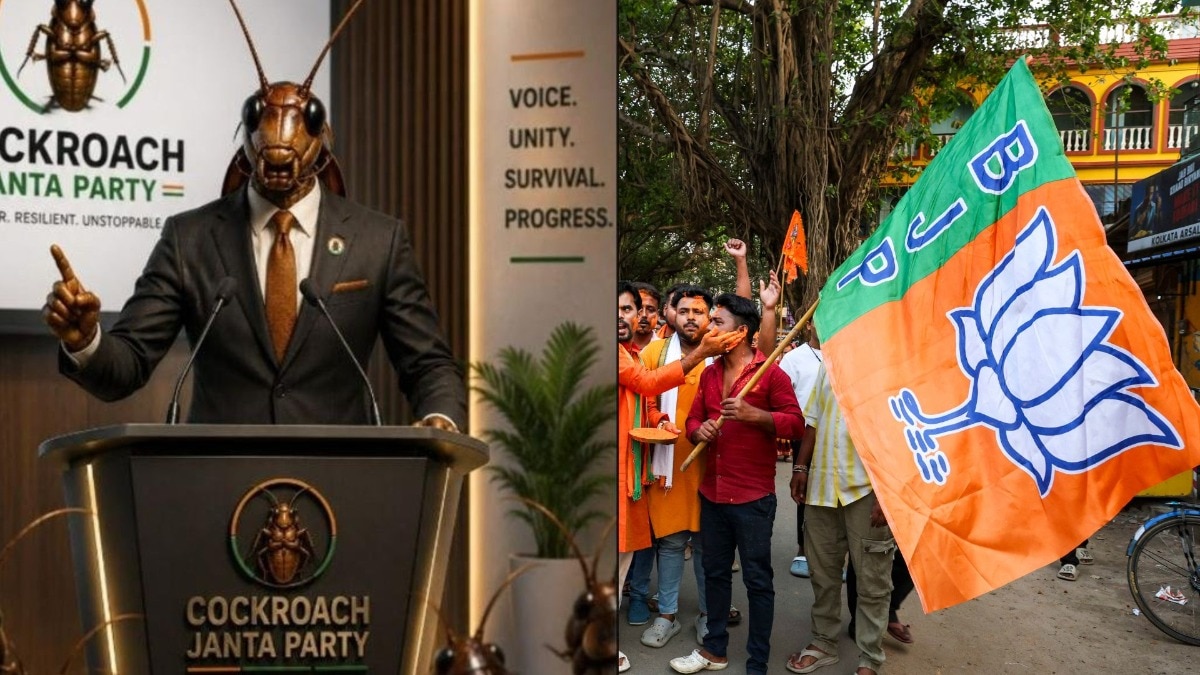
What started as a satirical campaign is now overtaking India’s most powerful political parties in online battles. The Cockroach Janta Party (CJP), a meme-fuelled satirical political movement born out of outrage, irony, and online humour in response to the Chief Justice of India’s remarks on youth, has crossed 10 million followers in just five days, overtaking the BJP on the platform.
In a country where political dominance has been carefully cultivated over decades, the online party has managed to outpace the ruling party armed with nothing more than sarcasm, reels, and viral rage.
The account, operating under the handle @cockroachjantaparty, crossed the 10-million mark on Thursday. In contrast, the BJP’s official Instagram account @bjp4india currently has around 8.7 million followers, while the Congress’s account @incindia remains ahead with roughly 13.2 million followers. The Aam Aadmi Party (AAP), founded in 2012, has approximately 1.9 million followers.
Both politicians and vocal non-politician backers or sympathisers of the Cockroach Janta Party include prominent YouTubers and social media influencers like Dhruv Rathee, veteran activist-lawyer Prashant Bhushan. TMC leaders Mahua Moitra and Kirti Azad have also expressed their willingness to join the Cockroach Janta Party.
There is a health warning here. Getting online followers is very different from getting people to join as members of a political party. Membership indicates on-ground presence.
The CJP’s campaign first surfaced online on May 16 as a satirical youth movement responding to the controversial remarks of the Chief Justice of India (CJI) Surya Kant regarding sections of Indian youth.
During a hearing on May 15, the CJI referred to a lawyer’s social media conduct, saying, “There are youngsters, like cockroaches, who don’t get any employment or have any place in the profession. Some of them become media, some of them become social media, RTI activists, and other activists, and they start attacking everyone.”
These remarks sparked massive outrage on social media and gave birth to the CJP, a campaign headed by its founder Abhijeet Dipke.
“I think the remarks were more triggering because they came from the Chief Justice of India, who is the custodian of the Constitution, which grants us freedom of expression. Someone who is there to safeguard our freedom of expression is comparing us to cockroaches and parasites just for putting forward our opinions. That was the more hurtful part,” Dipke said in an interview with India Today TV on Tuesday.
Dipke further argued that had similar remarks come from political leaders, the reaction may not have been as intense. “Had this comment been made by anybody else from the ruling party, which they normally do, it wouldn’t have caused such a stir. But it came from someone who is supposed to protect our freedom of expression,” Dipke added.
However, the CJI later issued a clarification of the cockroach statement on May 16, saying that he was “misquoted by a section of media”.
“I am pained to read how a section of the media has misquoted my oral observations made during the hearing of a frivolous case yesterday. What I had specifically criticised were those who have entered professions like the Bar (legal profession) with the aid of fake and bogus degrees. Similar people have sneaked into the media, social media, and other noble professions as well, and hence, they are like parasites. It is totally baseless to suggest that I criticised the youth of our nation,” CJI Surya Kant said in his clarification.
But the clarification did not settle down, and the CJP’s social media outrage continued to battle the system.
The CJP that initially appeared to be another fleeting meme page within days evolved into a full-fledged digital movement tapping into frustrations around unemployment, exam paper leaks, political accountability, and what many young users describe as a widening disconnect between institutions and Gen Z concerns.
Describing itself as “a political front of the youth, by the youth, for the youth,” the page rapidly gained traction among younger social media audiences. Within just 78 hours of launch, the account reportedly crossed 3 million followers before surging past 10 million in less than five days. This pace of growth in social media is rarely seen in India’s political social media landscape.
The scale of the CJP’s rise becomes more striking when compared with established political organisations like the BJP. Despite having only 56 posts so far, the CJP has managed to surpass the BJP’s Instagram following, even though the ruling party’s account has published more than 18,000 posts over the years.
This could be indicative of the youth appeal of the CJP. However, online following could come from anywhere in the world.
The CJP’s Instagram handle marked the milestone with a direct message to the political establishment, saying, “Don’t underestimate the power of youth”.
In another viral post after overtaking the BJP’s follower count, the account mocked the ruling party’s long-held image as a mass organisation, posting, “World’s largest party, they said”.
The BJP, founded in 1980, remains the world’s largest political party by primary membership, with more than 140 million members globally.
Yet online, the emergence of the Cockroach Janta Party has reflected how digital influence today can be built not through decades of cadre-building, but through meme culture, algorithm-driven virality, and a language of political satire that resonates with younger audiences.
The movement has also gained massive support beyond Instagram. On X, where the CJP took birth as an online backlash, the account crossed more than 180,000 followers by May 21. The BJP has 23 million followers of X, and the Congress has 11.5 million followers.
CJP’s supporters have even begun discussing the formation of unofficial “state units” online. One user claiming to represent a “CJP Uttarakhand unit” posted a video on Tuesday requesting official recognition from the founders.
As the CJP’s popularity exploded, several public figures and politicians also engaged with the campaign online. Among them are TMC MPs Mahua Moitra, Kirti Azad, social activist Anjali Bhardwaj, and former civil servant Ashish Joshi. The CJP even jokingly claimed to have “admitted” the TMC MPs into the outfit.
Yet CJP’s founder Dipke insists the campaign is not interested in becoming another traditional political platform. According to him, many young supporters see the movement as an alternative to existing political structures rather than an extension of them.
“Gen Z wouldn’t like it if current politicians joined the CJP,” Dipke told India Today TV, adding that the movement does not want to induct established political faces into the platform.
The CJP’s success appears to signal an increasingly visible Gen Z political identity. The movement appears to be rooted less in conventional party structures and more in decentralised digital communities, irony and frustration-driven participation.
“I think, India ka Gen Z hamesha yahi tha (India’s Gen Z were always here),” Dipke said.
“Look at the kind of support we have received in just three days. Do you really think that is possible through any orchestrated campaign? No, it is not. It is frustration,” Dipke added.
On being asked whether the CJP is an organisation or only a social media trend, Dipke said, “If it were just a trend, more than two lakh people would not have registered on the website. Trends on social media don’t last beyond 24 to 48 hours.”
A cockroach has crawled its way into India’s political conversation. But this cockroach has appeared not through rallies or elections, but through memes, mockery and Gen Z frustration.
What began as a satirical response to remarks by CJI has now turned into a viral political phenomenon, with the Cockroach Janta Party (CJP) crossing 10 million Instagram followers in just five days and overtaking the ruling BJP on the platform.
Source: India Today