

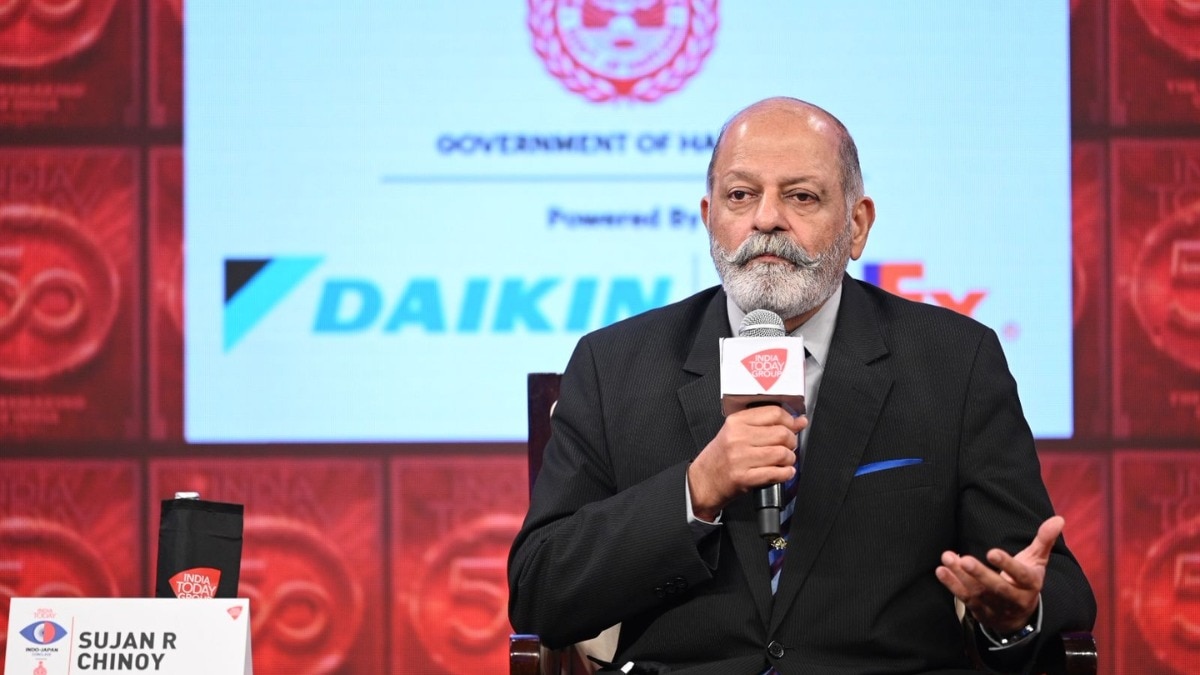
 Sujan R. Chinoy, Director General of the Manohar Parrikar Institute for Defence Studies and Analyses (MP-IDSA) and a former Ambassador of India to Japan, has called for stronger India-Japan ties, suggesting that the bilateral relationship had got a boost from factors such as India’s emergence as an economic power and China’s rising economic-military might and geopolitical assertion.
Chinoy was speaking during the session ‘Bilateral Boost: India-Japan in an Uncertain World Order’ at the third edition of the India Today Indo-Japan Conclave held in New Delhi on May 22.
Chinoy said that in the initial decades after India’s independence, Tokyo looked at New Delhi through the eyes of its own alliances and partnerships with the West, and “that put certain limits to the kind of engagement we could have otherwise achieved because of our historical relations”.
What then propelled the bilateral relations? Chinoy noted that it was India’s economic rise and emergence as an attractive economic destination for Japan. The close ties between India and the United States as well as other Organisation for Economic Cooperation and Development (OECD) countries was also an important aspect. “For Japan, that itself becomes a benchmark. Japan is heavily engaged with the West, especially OECD,” Chinoy said, adding that its way of doing business related to these standards.
The surge in China’s economy and military power, accompanied by irredentist claims in the East and South China Seas, had made Japan feel “a little more insecure and vulnerable”, and more inclined to look at like-minded partners to develop a better overall atmosphere for its own future. Japan was also expanding its defence and security partnerships with ASEAN (Association of Southeast Asian Nations).
“[There was also] growing realisation in Tokyo and New Delhi about the importance of building a regional consensus against unilateralism, monopolistic manipulation of critical supply chains as well as preventing and avoiding economic cohesion, which comes from extreme dependence on any single geography for economic engagement,” he said.
Prime Minister Narendra Modi and his Japanese counterpart Sanae Takaichi had a personal commitment to the future of the bilateral ties. There are no contentious issues between India and Japan, Chinoy pointed out.
The US move to impose unilateral trade tariffs and its statements against alliance partners seem to have strengthened Tokyo’s resolve to maximise other options as well such as building inclusive ties with countries like India and Australia. This was reflected in examples like the joint exercises of the three services of India and Japan, the two-plus-two ministerial level dialogue, and the joint declaration on security cooperation concluded in 2025. “All these became the cornerstone of our cooperation, at the heart of which is also the high-tech cooperation with regard to critical minerals, supply chains and industrial collaboration,” said Chinoy.
Chinoy added that Japan’s relationship with China was not unidimensional. Despite their contentious territorial differences over the sensitive Senkaku Islands, they continued to have a very strong economic partnership. Japan’s major supply chains, manufacturing activities, marketing, and hub and spoke design for the rest of the world came out of China. “But there is also a realisation that dependence on a single geography is not conducive to its own future,” Chinoy explained.
Therefore, Tokyo has often been speaking of the ‘China plus one’ policy to reduce its reliance on Beijing, and that plus one is not limited to just one country. India can aspire to be that one major partner for Japan. There were multiple players in the geographical stretch between India and Japan, such as Vietnam, Thailand and Taiwan, who vied with India for the same investments that are otherwise inclined to move out of China, and to alternative geographies.
“We have to work hard to ensure that Japan has a better choice in India,” said Chinoy, adding that India was a better choice as none of the other contending countries offered a full spectrum of economic activities. Bilateral economic partnerships had soared and today, Japan was one of India’s biggest investors in terms of cumulative investments, he said.
CHINOY-SPEAK
* “Swami Vivekananda had said he would like every young person from India to visit Japan at least once to see for themselves what Japan is capable of.”
* “We have this great civilisational link between India and Japan in which we celebrate our links through Buddhism, the seven lucky Gods. There is no other country in the world where you have Ganesha, Shiva, Saraswati, Lakshmi, all very much celebrated and part of the pantheon”
* “When Japan sees the rest of the world engaging India in a much tighter embrace, it is natural for it to feel the same impulse.”
* “Japan is a celebrated brand in India. It is a welcome partner in every part of this country, one that stands for quality, trust and reliability.”
* “We must work hard to ensure that the China-plus policy veers increasingly towards India.”
Subscribe to India Today Magazine
Source: India Today