

 The Middle East has rarely felt this unstable. Gaza bleeds. Houthi drones circle over Red Sea shipping lanes. The Strait of Hormuz—that narrow stretch through which a fifth of the world’s oil flows daily—sits permanently on the edge, hostage to the slow-motion confrontation between Iran and the US-Israel axis.
Oil prices lurch. Container routes are being changed. And the geopolitical map of West Asia, redrawn by the Arab Spring and the Abraham Accords, is shifting yet again under the weight of the ongoing conflict.
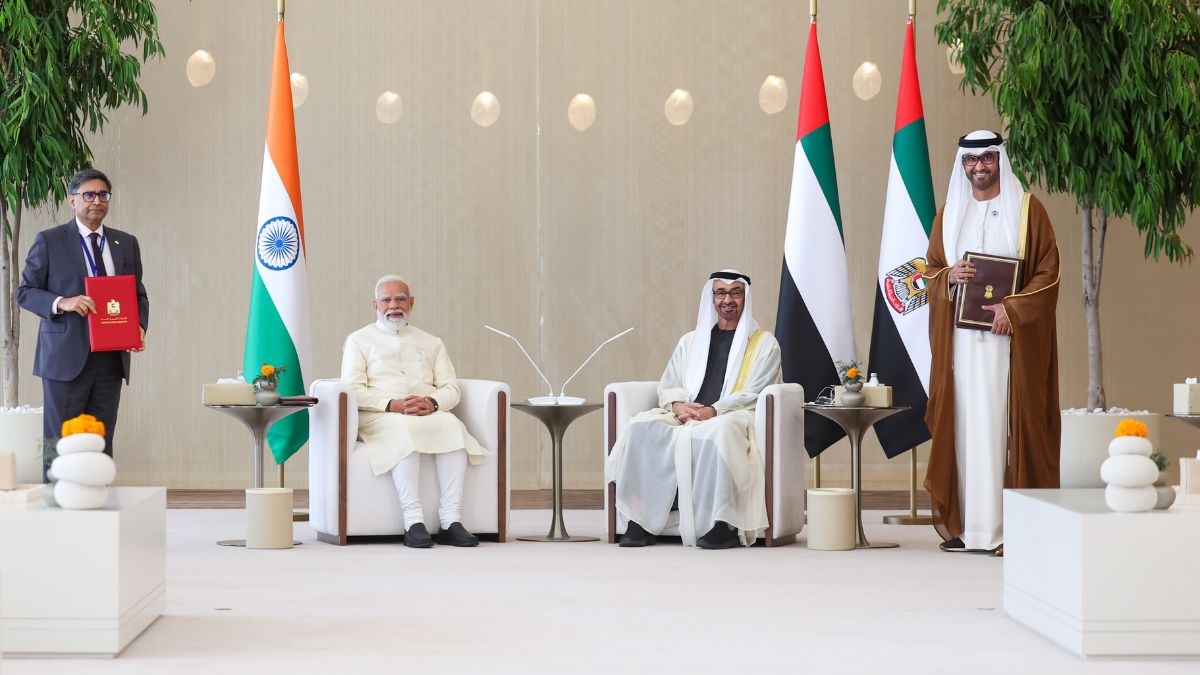
Amidst these volatile circumstances, Prime Minister Narendra Modi arrived in the United Arab Emirates, and what he is building there is anything but routine diplomacy. For most of the past half century, India’s relationship with the Gulf was essentially a bargain of convenience: crude oil, remittances and millions of Indian workers shuttling between the two worlds.
That bargain served both sides adequately. But it was never a strategy. Today, that is precisely what India and the UAE are constructing—a strategic corridor spanning energy, defence, maritime industry, sovereign capital and artificial intelligence, designed to give both nations resilience in an uncertain era.
The foundation beneath these developments is the Comprehensive Economic Partnership Agreement already signed between the two countries, which has pushed bilateral trade to record levels and created the commercial infrastructure within which this deeper strategic partnership is being built.
Begin with oil, because oil is where everything in this region ultimately begins. India is the world’s third-largest consumer of crude oil, importing close to 90 per cent of what it burns. Half of that comes from Saudi Arabia, Iraq and the UAE, all of it passing through the Strait of Hormuz. That single chokepoint is the daily reality underpinning the Indian economy right now.
Against that exposure, India’s strategic oil reserves are a study in inadequacy: three underground caverns at Visakhapatnam, Mangalore and Padur, covering only 9.5 days of crude oil requirement at full capacity, and currently filled to just 64 per cent, covering five days.
Japan holds over 200 days of oil reserves, China over 100. The International Energy Agency (IEA) recommends 90 days. The United States held 413 million barrels as of late last year. India’s entire stockpile fits inside that number more than 10 times over.
Successive Indian governments deferred filling even existing capacity against competing fiscal priorities while consumption skyrocketed from 158 million metric tonnes in 2013-14 to 239 million metric tonnes in 2023-24. A parliamentary standing committee as recently as March 2026 urged the government to reach the 90-day benchmark, a target that has remained aspirational for decades.
This is the context that gives the ADNOC-ISPRL deal its true weight. It is India’s attempt to compensate, through partnership and geographic distribution, for the strategic depth it has never managed to build domestically. By securing storage rights at Fujairah outside the Hormuz chokepoint, India gains a buffer that its own caverns cannot provide.
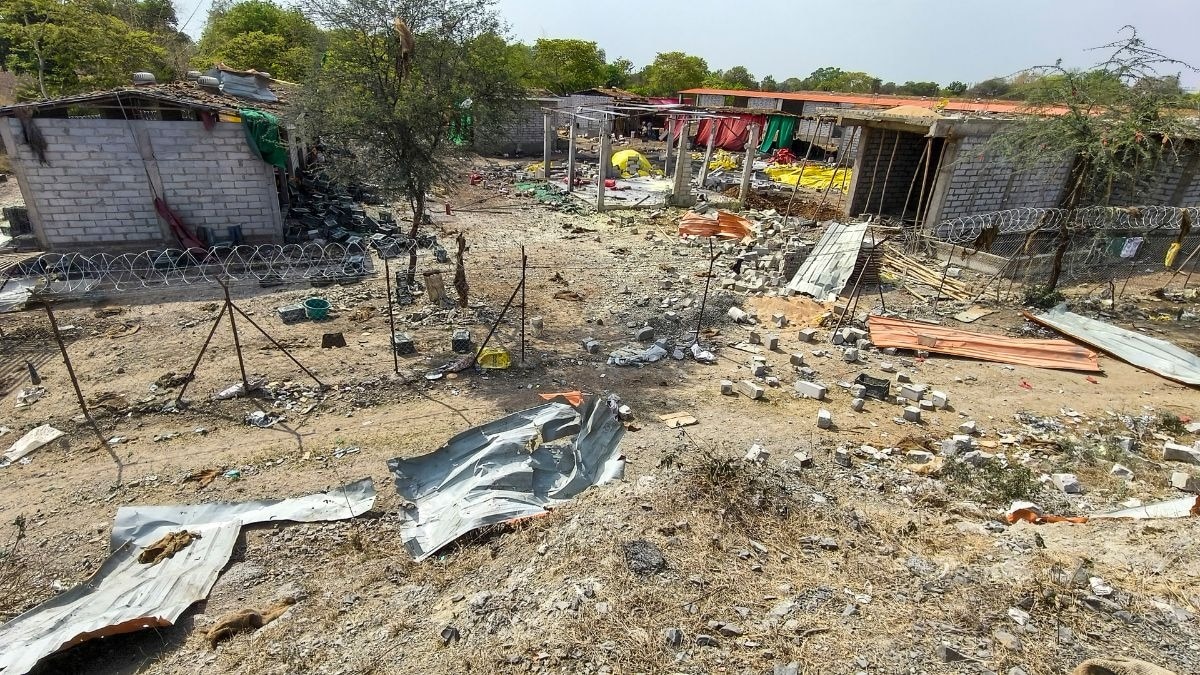
The two sides also committed to establishing strategic gas reserves inside India, beginning to address the country’s near-total absence of any gas equivalent to its petroleum buffer. The West Asia region has already faced Iran’s barrages of missiles and drones, intercepted by UAE air defence systems, a reminder that the threats animating these agreements are not hypothetical. Modi’s formal declaration during the visit in favour of unimpeded navigation through the Strait of Hormuz was, therefore, a statement on existential national interest.
Energy, however, is only the foundation. Built atop it is a maritime layer that reflects a sharper strategic ambition. The memorandum of understanding between Cochin Shipyard Limited and Drydocks World to develop a ship repair cluster at Gujarat’s Vadinar signals genuine intent to enter a global industry long dominated by China, South Korea and Japan.
India, despite 7,500 km of coastline astride major shipping lanes, has remained largely marginal to this ecosystem. That marginality is now becoming untenable. Maritime infrastructure is no longer merely commercial infrastructure. It is geopolitical infrastructure. China understood this early and built it relentlessly through the Gwadar, Hambantota and Djibouti ports. Its Belt and Road Initiative was, at its core, an infrastructure-power strategy.
India and the UAE are assembling an alternative, rooted less in debt leverage and more in shared industrial interest. A tripartite skills agreement, covering shipbuilding and repair workforce development, and the operationalisation of the MAITRI Virtual Trade Corridor, connecting customs and port authorities on both sides, complete this layer. Physical ports and digital corridors are being built in tandem, each reinforcing the other.
The defence framework signed during the visit covers defence industrial collaboration, cyber security, interoperability, secure communications, special operations and maritime security. The logic is plain. The American security umbrella over the Gulf is no longer treated as permanent by either Abu Dhabi or New Delhi. China’s naval presence in the Indian Ocean is expanding steadily. Pakistan’s maritime alignment with Beijing deepens the calculus.
Iran-linked disruption periodically threatens the sea lanes that carry a disproportionate share of global energy and trade. Both India and the UAE are quietly investing in a middle-power maritime compact—not a formal alliance, not a military bloc, but a deepening web of interoperability and aligned interests in keeping the Arabian Sea open and stable.
The term sheet between CDAC and UAE-based G42 to establish an eight-exaflop supercomputing cluster under India’s AI Mission may be the most forward-looking agreement of Modi’s visit. Exaflop-scale computing powers advanced artificial intelligence, defence simulations, climate modelling, genomics and sovereign data infrastructure. Until recently, the AI race looked like a two-horse contest between the US and China. India and the UAE are positioning themselves as a third pole, building sovereign capability outside that binary.
The UAE brings capital, aggressive AI ambition and a demonstrated willingness to back high-stakes technology bets. India brings engineering talent at scale and the world’s largest pool of AI developers outside the United States. What neither has alone, they may begin to build together: a technology corridor spanning AI infrastructure, cloud systems and eventually semiconductor ecosystems, anchored in a new India-Gulf axis.
The financial agreements complete the architecture. Emirates NBD is committing $3 billion into RBL Bank. The Abu Dhabi Investment Authority (ADIA) is investing $1 billion with India’s National Investment and Infrastructure Fund in priority infrastructure projects. International Holding Company is deploying $1 billion into Sammaan Capital.
The total announced UAE investment into India stands at $5 billion. India’s combination of scale, political continuity and infrastructure ambition makes it one of the few economies capable of absorbing long-duration sovereign capital at the volumes Gulf funds need to deploy. The eastward reorientation of Gulf capital is likely to accelerate.
None of this exists outside the region’s fault lines, which are multiplying. What was once a manageable confrontation between the US, Israel and Iran, conducted through proxies and calibrated pressure, is increasingly playing out in the open. A hot war involving Iran would not stay contained. It would detonate across every dimension of what is being built: energy routes severed, shipping lanes closed, investment flows frozen.
The fracturing within the Arab world itself is equally consequential. The UAE’s decision to exit the Saudi Arabia-led OPEC (Organization of the Petroleum Exporting Countries) framework was a declaration of strategic independence—Abu Dhabi signalling it would act on its own interests. Saudi Arabia is constructing NEOM and projecting Vision 2030, positioning itself as the Gulf’s dominant power.
The UAE is building something different: a nimbler, more globally integrated node that competes with its larger neighbour as often as it cooperates. Qatar leverages energy and diplomacy. Turkey presses through manufacturing and logistics. Egypt navigates its own precarious balance.
Into this landscape comes one of the more startling recent developments: Israel is reportedly installing an air defence system in the UAE. That a country still formally at war with much of the Arab world is now providing military protection to a Gulf state speaks volumes about how radically the regional security architecture has been rewired. It reveals how seriously Abu Dhabi takes the Iranian threat, seriously enough to accept Israeli hardware on its soil.
It is then telling that Modi formally reaffirmed India’s condemnation of the attacks on the UAE during the visit, expressing solidarity with its leadership and people. That gesture was a public acknowledgement that the UAE faces live threats and that India stands on its side.
The significance of this visit is not captured by any single agreement but the architecture these pacts collectively reveal: oil reserves, maritime clusters, AI infrastructure, defence frameworks, sovereign capital and digital trade corridors being deliberately woven into a single strategic vision. The India-UAE relationship is no longer transactional. It is becoming load-bearing.
The old global order, built on stable supply chains and predictable alliances, is weakening. In its place, countries are constructing bilateral corridors anchored by trusted partnerships and distributed resilience. Oil, oceans and algorithms are the currencies of this new order. India and the UAE are building their corridor now. When the history of this era is eventually written, this quiet construction may be seen as one of the more consequential bets placed in a world learning, urgently, to hedge.
Subscribe to India Today Magazine
Source: India Today