

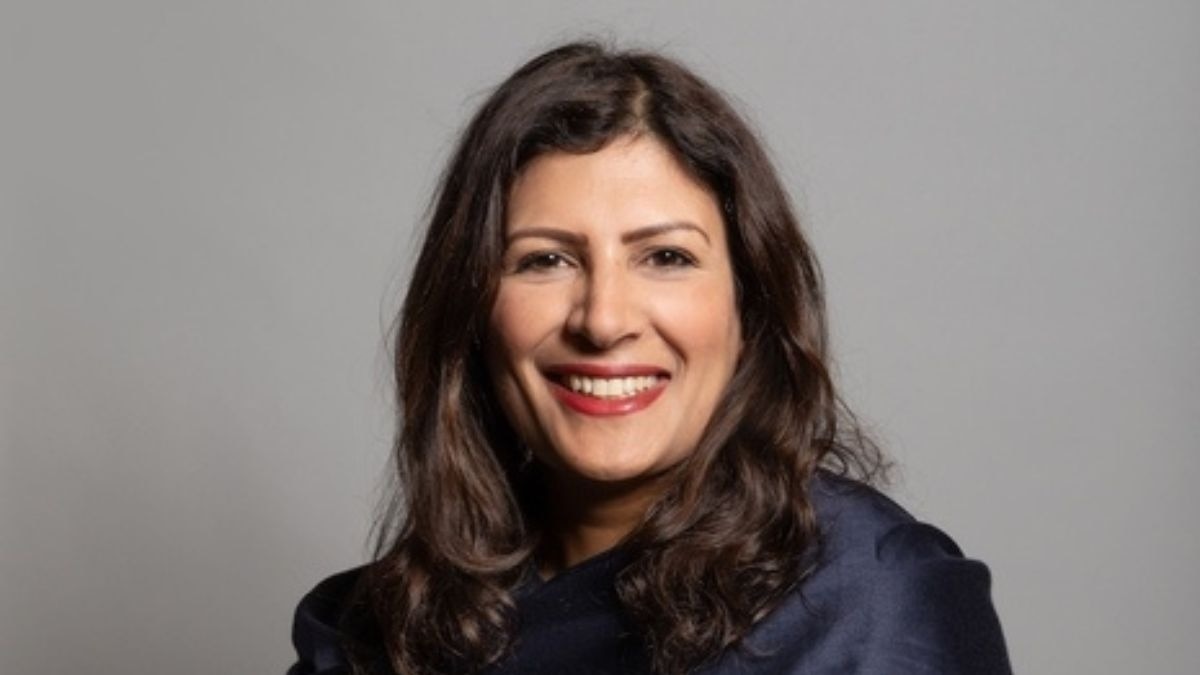
 Her father drove buses in Birmingham. Her mother stitched clothes for a living. They had come from Punjab with little else than the hope that England might offer their children something the village of Jamsher in Jalandhar could not. What they could not have imagined—and perhaps no one could—is that their eldest daughter would one day sit in the British government and shape the future of the health service there.
Preet Kaur Gill was appointed parliamentary under-secretary of state in the Department of Health and Social Care on May 12. She was one of seven appointments announced that day. Gill is the first woman British Sikh MP in the history of the House of Commons. Her appointment deepens a pattern of South Asian representation that has become one of the more striking features of the Keir Starmer government.
Home secretary Shabana Mahmood, of Pakistani descent, has emerged as one of the most powerful figures in the cabinet. Lisa Nandy serves as culture secretary, the first Labour cabinet minister of Indian origin. Seema Malhotra is the minister for equalities. Kanishka Narayan serves as parliamentary under-secretary of state for AI and online safety.
Gill’s appointment to health adds another name to a generation of South Asian politicians who have moved from the margins of British public life to its very centre. She arrived at this brief carrying something that most ministers do not: a lived understanding of what it means to need a health system, and to find it wanting.
In her first interview since the appointment, given exclusively to INDIA TODAY, Gill sets out a sweeping reformist vision for UK’s National Health Service (NHS), one driven by AI and preventive care, a tighter framework for patient safety, and a deepening partnership with India that she believes could reshape how both countries deliver healthcare in the decades ahead.
“The biggest challenge,” she says, “is ensuring that NHS remains both sustainable and equitable in the face of rising demand. We are dealing with an ageing population, growing long-term conditions, workforce pressures, and the need to modernise systems that were not designed for the digital age,” says Gill.
But this, she insists, is not solely a story of strain. It is also a story of timing, and the timing, she argues, may be unusually good. AI, genomics, advanced diagnostics and digital care platforms are beginning to reshape the contours of healthcare delivery, shifting emphasis from episodic treatment towards prevention, prediction and personalisation. For policymakers, this creates both a technical and a political challenge: how to integrate new tools into a system built on universality, equity and clinical conservatism.
India, which is simultaneously building out its own digital health architecture under the Ayushman Bharat Digital Mission while managing one of the world’s largest and most complex patient populations, faces a version of this same challenge at far greater scale and with far fewer resources per capita.
“This is also a moment of enormous opportunity,” says Gill. “Advances in AI, diagnostics, genomics and digital healthcare can help us move from a reactive system to a more preventative and personalised model of care. The challenge is making sure innovation reaches every patient, not just a few regions or hospitals.”
That distinction between technological advancement and equitable access runs through much of her early framing of the portfolio. Innovation, she suggests, is no longer the constraint. Distribution is. The question is not whether new technologies exist, but how they are embedded across an unequal and geographically diverse healthcare landscape without amplifying existing disparities.
It is a question India has been grappling with for decades as the gap between healthcare in its metropolitan centres and its rural hinterland remains one of the most stubborn challenges facing the public health system.
This balance becomes especially sensitive in the context of AI, where adoption has accelerated faster than regulatory frameworks in many countries. The UK has already begun integrating AI tools in diagnostics, imaging and administrative systems, but concerns over transparency, bias and clinical accountability remain central to policy debate.
For Gill, the emphasis is on controlled acceleration rather than unrestricted deployment. Public trust, she argues, remains the essential currency of healthcare reform. “People need confidence that new technologies are clinically safe, ethically governed and properly regulated,” she says. “The role of government is to create a framework where innovation can move faster without compromising transparency, accountability or patient safety. That includes robust oversight of AI systems, clear standards for health data governance and ensuring clinicians remain central to decision-making.”
Gill is also direct about one of the most politically charged risks of AI in healthcare—the danger of algorithmic bias. “We have to guard against bias in datasets and ensure technologies work fairly across diverse populations,” she says. “Patients should know when AI tools are being used.”
For India, where datasets often underrepresent women, rural populations and lower-income groups, this warning carries particular weight. Building AI tools on skewed data risks institutionalising, rather than correcting, existing inequalities in care.
While the domestic reform agenda is substantial, Gill’s brief is equally shaped by the international context. The post-pandemic era has exposed the fragility of global supply chains for medicines, vaccines and medical technologies, and governments are now rethinking dependencies that were previously taken for granted. It is in this environment that India has emerged as a key partner for the UK across pharmaceuticals, vaccine production, clinical research and digital health.
For Gill, this is not a distant diplomatic relationship. It is, in a sense, personal. Her roots are Punjabi. Her father presided for nearly two decades over the Guru Nanak Gurdwara in Smethwick, the first gurdwara established in the UK. She understands, intuitively, the connections that bind the two countries beneath the level of policy.
But she is equally clear about the strategic logic. “India and the UK have complementary strengths,” she says. “The UK has globally respected research institutions, innovation ecosystems and regulatory expertise, while India has enormous strengths in pharmaceuticals, vaccine production, digital scale and med-tech manufacturing.”
This framing moves the conversation beyond traditional trade-based cooperation into what she describes as resilience-oriented partnership, focused not merely on market access but on building redundancy and reliability into global health systems. “There is significant scope for collaboration in medicines and supply-chain resilience as one of several areas for cooperation in the 2025 UK-India Health and Life Sciences Memorandum of Understanding,” she says. “Trusted international partnerships will become increasingly important as countries seek to reduce vulnerabilities exposed during the pandemic.”
The word “trusted” is deliberate. It reflects a broader shift in global health governance, where geopolitical alignment and institutional credibility are increasingly shaping cooperation frameworks. Healthcare is no longer insulated from strategic considerations. It is embedded within them.
Alongside pharmaceuticals and supply chains, digital health has become another axis of convergence. India’s rapid expansion of digital public infrastructure, telemedicine platforms, large-scale health databases, and Ayushman Bharat has drawn serious attention from policymakers globally, particularly for its ability to deliver services at scale across enormously diverse populations.
Gill sees these not as alternative models to the NHS, but as sources of mutual learning. “India’s rapid expansion of digital public infrastructure and telemedicine has attracted global attention because of the scale and speed at which services have been delivered,” she says. “The UK’s experience with universal healthcare and integrated clinical systems offers lessons in continuity of care, patient standards and regulatory governance. There is huge potential for mutual learning, particularly around interoperability, digital inclusion and secure health data systems.”
The areas of potential exchange are concrete. India could draw on the NHS experience in building integrated care pathways, managing chronic disease at a population level, and developing robust clinical governance frameworks that hold both public and private providers to consistent standards. The NHS, in turn, has much to learn from India’s capacity for frugal innovation, its experience in delivering care in low-resource settings, and the sheer ambition of platforms such as CoWIN, which administered over two billion vaccine doses with a speed and reach that health systems in far wealthier countries struggled to match.
The future of cooperation, in her view, lies in interoperability rather than convergence. Systems need not look alike to work together, but they must be able to communicate across technological and institutional boundaries, a principle with direct implications for how India and the UK share data, align clinical standards and develop joint research frameworks.
The conversation returns repeatedly to the question of equity, both within the NHS and across healthcare systems globally. Within the UK, Gill is candid about the risk of regional concentration: that new investment and innovation will cluster in major urban centres and high-capacity institutions, leaving communities elsewhere further behind.
“One of my priorities is ensuring healthcare innovation does not become geographically concentrated,” she says. “Too often, communities outside major urban centres can feel left behind by new investment or technology. We need regional health innovation partnerships, stronger community healthcare infrastructure, and digital access that works for everyone.”
It is a conviction rooted as much in biography as in policy. She grew up in Edgbaston, the daughter of immigrants who depended on public services and community institutions to build a life in Britain. That experience, she says, shapes how she approaches reform, not from the top down, but from lived reality outward. “Healthcare reform cannot simply be about systems and structures,” she says. “It must ultimately improve the daily lives of patients, families and frontline staff.”
Gill also situates British Indians explicitly within the architecture of UK-India cooperation, not as a symbolic gesture, but as a recognition of functional contribution across medicine, nursing, research and healthcare entrepreneurship. “The contribution of the British Indian community to the NHS and wider healthcare system is immense and deeply valued,” she says. “Across medicine, nursing, pharmacy, research, social care and healthcare entrepreneurship, British Indians have helped shape modern healthcare in the UK. The NHS would simply not be what it is today without the contribution of communities from India and the wider South Asian diaspora.”
Coming from her, it is something more than a ministerial acknowledgement. It is a statement about her own family’s journey, from Punjab to Birmingham, from the gurdwara in Smethwick to the corridors of Westminster, and about what that journey represents for the relationship between two countries whose health futures are, she believes, increasingly intertwined.
As healthcare systems globally confront simultaneous pressures of ageing populations, technological acceleration and geopolitical fragmentation, Gill’s framing reflects an attempt to hold all of it in view at once: domestic reform and international alignment, speed and caution, innovation and equity. Her central conviction, stated plainly and returned to often, cuts through the complexity. “Innovation,” she says, “must reach every patient. Not just a few regions. Not just a few hospitals. Every patient.”
Subscribe to India Today Magazine
Source: India Today