

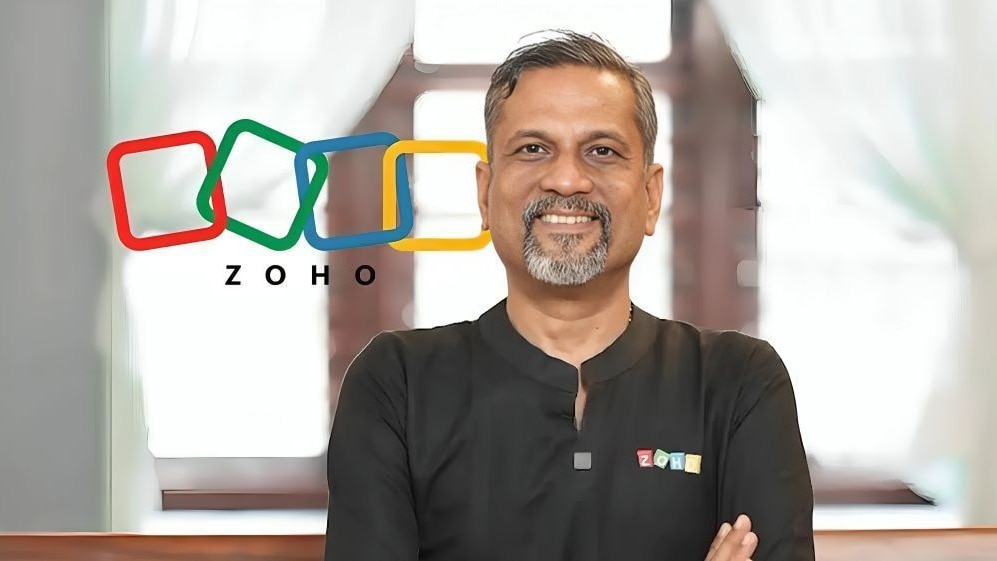
As India debates whether work-from-home should return in some form to cut fuel consumption during a period of global uncertainty, Sridhar Vembu has made it clear that Zoho is not planning to expand remote work for employees. The company’s founder said face-to-face collaboration still delivers better results, especially for research and development teams, even as Prime Minister Narendra Modi recently encouraged companies and citizens to revive some Covid-era habits like online meetings and remote work to reduce fuel usage.
In a detailed post on X, Vembu said the company internally discussed the idea after his earlier comments on work culture sparked reactions online. However, he revealed that Zoho eventually decided against increasing work-from-home options because in-person teamwork continues to be more effective for solving complex problems.
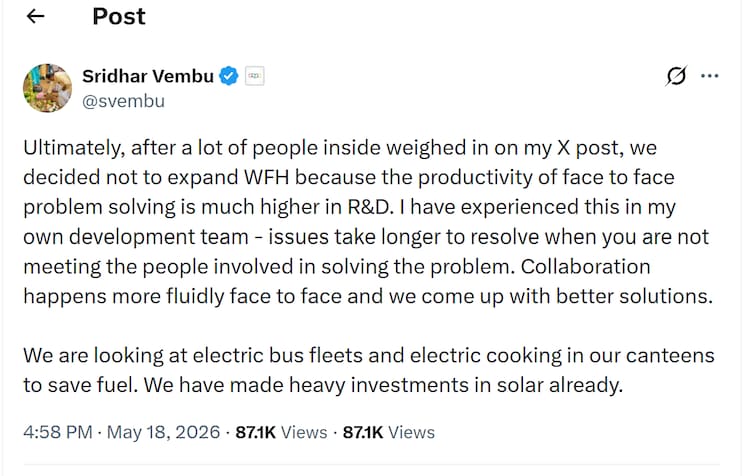
“Ultimately, after a lot of people inside weighed in on my X post, we decided not to expand WFH because the productivity of face to face problem solving is much higher in R&D,” Vembu wrote.
He added that his own experience with development teams showed that issues often take longer to resolve when employees are working remotely. According to him, spontaneous collaboration happens more naturally when teams are physically present together, leading to better ideas and faster solutions.
“I have experienced this in my own development team – issues take longer to resolve when you are not meeting the people involved in solving the problem. Collaboration happens more fluidly face to face and we come up with better solutions,” he said.
Vembu’s remarks come at a time when the Indian government is encouraging people and businesses to reduce unnecessary fuel consumption due to the economic pressure linked to the ongoing West Asia conflict. In a recent address, PM Modi urged Indians to reconsider practices widely adopted during the Covid-19 pandemic, including work-from-home arrangements, virtual conferences and reduced travel.
The Prime Minister framed the appeal as an economic and energy-security measure rather than a health-related precaution. He stressed that India should prepare for global instability by lowering dependence on imported fuel and cutting avoidable consumption of petrol and diesel.
“We must prioritise work from home, online conferences, and virtual meetings again,” Modi had said.
He also encouraged greater use of public transport systems like metros, along with carpooling whenever private vehicles are necessary. Beyond commuting habits, Modi asked citizens to avoid unnecessary foreign travel, postpone destination weddings abroad and reduce non-essential gold purchases for the time being.
While Zoho is not increasing work-from-home options, Vembu said the company is still exploring ways to reduce fuel consumption and improve sustainability. He revealed that Zoho is considering electric bus fleets for transportation and electric cooking systems in company canteens. He also highlighted the company’s investments in solar energy infrastructure.
“We are looking at electric bus fleets and electric cooking in our canteens to save fuel. We have made heavy investments in solar already,” he wrote.
The comments add another layer to the wider conversation around workplace culture in India’s tech industry, where companies remain divided on remote work even years after the pandemic. While some firms continue to offer hybrid flexibility, others increasingly believe that office-based collaboration improves creativity, innovation and team coordination.
Interestingly, Vembu has also been actively sharing his thoughts on how technology and artificial intelligence could change society and work itself. In another recent discussion on X, he argued that jobs centred around caregiving, teaching, farming, spirituality and culture may remain meaningful in the AI era because they are driven more by purpose than financial rewards.
His comments came amid growing global debates over whether AI could eventually replace many traditional white-collar jobs. Tech leaders like Elon Musk and Jensen Huang have also spoken recently about how AI could transform the future of work, though opinions remain sharply divided on whether AI will eliminate jobs or simply change how humans work.
Source: India Today