

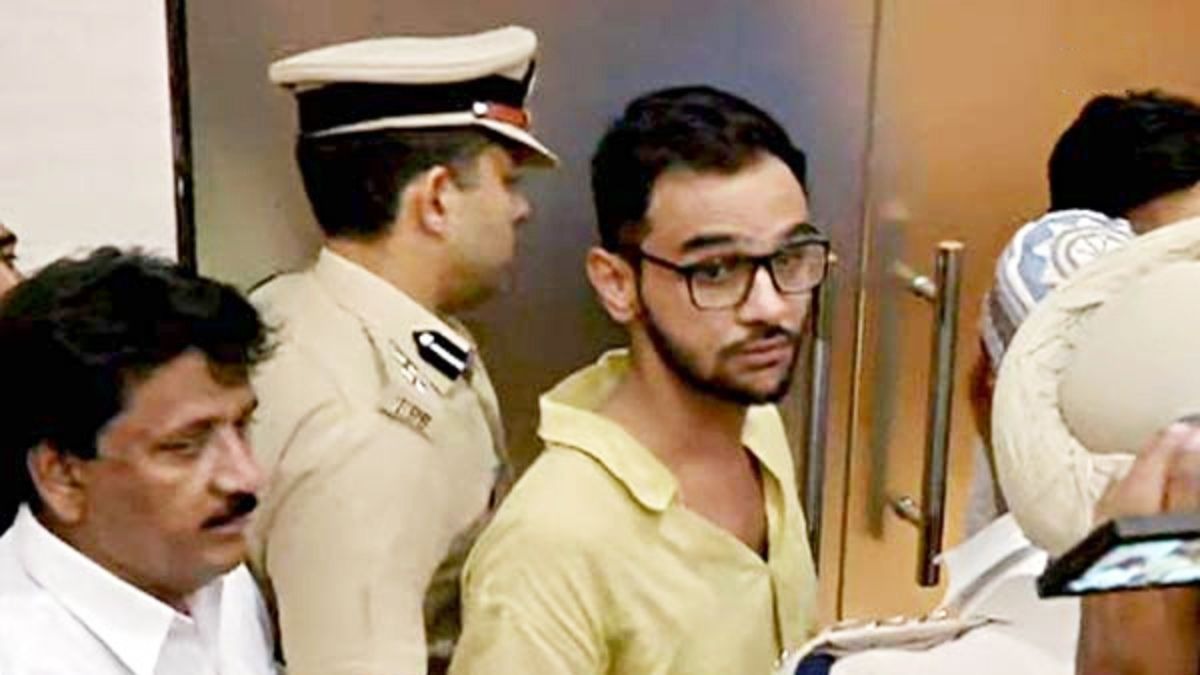
 On May 19, a Delhi court refused Umar Khalid even a fortnight of interim bail. A day earlier, the Supreme Court had declared that under the Unlawful Activities (Prevention) Act (UAPA), India’s principal anti-terror law, “bail is the rule and jail is the exception”.
The two-judge bench of Justices B.V. Nagarathna and Ujjal Bhuyan had gone further still: it openly faulted an earlier Supreme Court order that rejected Khalid’s bail, and rested its reasoning on a 2021 precedent—Union of India vs K.A. Najeeb.
Confused? The Delhi police are too; so confused that they have asked the Supreme Court to refer the entire question to a larger bench. Two sets of the Supreme Court’s own judges of equal rank are saying opposite things, and the police would like to know which is the law.
To understand how the country’s apex court ended up arguing with itself, let’s begin with the man at the centre of it all: Khalid.
In February 2020, north-east Delhi burned during protests against the Citizenship (Amendment) Act, 2019, and the proposed National Register of Citizens (NRC). Fifty-three people died and more than 700 were injured. That September, the Delhi police arrested Khalid, then 33, in the “larger conspiracy” case, booking him under UAPA and the penal code as one of the alleged masterminds of the violence.
Khalid has been in Tihar Jail ever since. The trial, in any meaningful sense, has barely begun. His record on bail is a study in near-permanence. The trial court refused him regular bail. On October 18, 2022, the Delhi High Court did too, holding that he was in “constant touch” with the co-accused, that the allegations were “prima facie” true, and that his alleged acts qualified, on the face of it, as a “terrorist act”.
Khalid took the matter to the Supreme Court in 2023, where it was deferred more than 10 times, one judge recused himself, and Khalid eventually withdrew the plea in February 2024, citing changed circumstances, to try his luck again at the trial court.
Khalid has been let out only in brief, conditional bursts—a week in 2022 for his sister’s wedding (with a gag order barring him from speaking to the media), again in 2024, and once more in December 2025. He surrendered on time on each occasion.
Then, on January 5 this year, a Supreme Court bench of Justices Aravind Kumar and N.V. Anjaria refused Khalid regular bail once more, finding that he met the statutory threshold for denial under UAPA on account of his alleged role in the “planning, mobilisation and strategic direction” of the riots. The same bench granted bail to five co-accused, including Gulfisha Fatima. Khalid was told he could renew his plea after a year.
By then his case had become the example everyone used when arguing about UAPA bail. At the Jaipur Literature Festival in mid-January, former chief justice of India D.Y. Chandrachud, pressed on Khalid by name, said that bail before conviction is “a matter of right”, that national security cannot be a blanket reason to deny it, and that “if an expeditious trial is not possible, then bail should be the rule and not the exception”.
The reason UAPA bail is so vexed lies in one provision: Section 43D(5). In ordinary criminal law, an accused is presumed innocent and bail is, broadly, the default. The UAPA reverses that. If a court, reading the case diary and chargesheet, finds reasonable grounds to believe the accusation is prima facie true, it must refuse bail. The accused is, in effect, asked to dislodge the prosecution’s case before the trial has even tested it—a near-impossibility at the bail stage.
Two Supreme Court judgments have pulled this clause in different directions. In NIA (National Investigation Agency) vs Zahoor Ahmed Shah Watali (2019), the court read 43D (5) strictly: a judge must take the prosecution’s material largely at face value and may not weigh its evidentiary worth. After Watali, bail under the UAPA became something close to unobtainable.
Then came K.A. Najeeb. On February 1, 2021, a three-judge bench held that even where 43D (5) applies, prolonged incarceration, coupled with an indefinitely delayed trial, is an “independent” ground for bail, drawn not from the statute but from Article 21 of the Constitution—the right to life and to a speedy trial.
The restrictive clause, the court said, limits a court’s power; it does not extinguish the constitutional duty to protect liberty. The two rulings are not strictly contradictory: Watali is the statutory lens, Najeeb the constitutional one. The trouble is which lens a judge chooses to look through.
The January 2026 bench (Justices Kumar and Anjaria) looked through the Watali lens, applying the strict statutory bar to Khalid and another accused Sharjeel Imam.
Four months later, the May 18 bench looked through Najeeb. Granting bail to Syed Iftikhar Andrabi, a Jammu and Kashmir man who had spent nearly six years in custody in an NIA narco-terror case without trial, Justices Nagarathna and Bhuyan reaffirmed that bail is the rule even under UAPA, that 43D(5) “cannot extinguish” Article 21, and that “the more serious the accusations are, the speedier the trial should be”.
Then came the sharper point—an institutional one. A smaller bench, Justice Bhuyan wrote, is bound by a larger one. It cannot “dilute, circumvent or disregard” the law laid down by more judges. If it genuinely doubts a precedent, judicial discipline requires it to refer the question upward, not to quietly chip away at it. He named the January 2026 ruling and an earlier 2024 judgment, Gurwinder Singh, as having strayed from the three-judge Najeeb ruling. Both, as it happened, were authored by Justice Kumar.
One detail is easily lost in the noise: the May 18 order granted bail to Andrabi, not to Khalid. The bench could only criticise the reasoning that had kept Khalid in jail; sitting as a bench of equal strength, it could not overturn it.
The plea Khalid lost on May 19 was not for regular bail but for 15 days of “interim” bail—emergency relief on humanitarian grounds to care for his mother after a surgery, and to attend the chehlum (40-day ritual) for an uncle who had died.
Additional sessions judge Sameer Bajpai of the Karkardooma court in Delhi was unmoved. The uncle, he reasoned, was not a close relative, and had the bond been so immediate, Khalid would have sought release at the time of the death, not weeks later. The mother’s surgery was minor—the removal of lumps, and a 71-year-old father and five sisters could see to her care even if they lived elsewhere. The grounds, he held, did not seem “just”.
Interim bail turns on urgency, not the grand constitutional question, and trial judges rarely free a man the Supreme Court has just refused to free, especially when the apex court’s own order had asked him to wait a year. The “bail is the rule” sermon, however resonant, had been delivered in another man’s case. Which brings us back to the confusion, and to the prosecution, of all parties asking the court to end it.
Coordinate benches of the Supreme Court—two judges each, equal in authority—are now pulling in opposite directions on the same statute. Appearing before Justices Kumar and P.B. Varale in the bail pleas of two other riots-conspiracy accused, Tasleem Ahmed and Khalid Saifi, additional solicitor general S.V. Raju asked that the conflict be referred to a larger bench to settle the law once and for all.
Notably, he did not oppose interim bail; yet what the police want is certainty. Until a larger bench rules, India keeps both propositions on its books at once: bail is the rule, and, for some, jail is the rule.
Subscribe to India Today Magazine
Source: India Today