

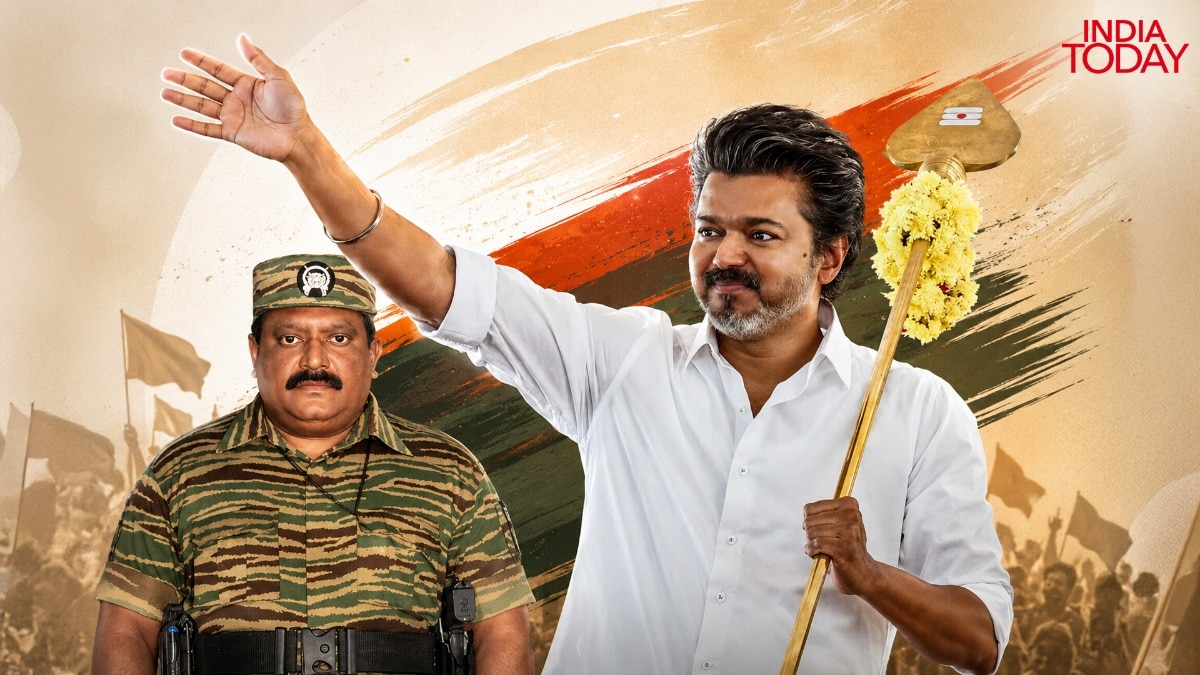
In 2008, at the height of the Sri Lankan government’s military offensive against Tamil militants, actor Vijay joined a hunger strike in Chennai in solidarity with Sri Lankan Tamils. “Let freedom dawn for Eelam Tamils,” he appealed, urging “everyone who carries the essence of Tamil identity within them” to support the cause. The actor also invoked the imagery of Tamil valour, declaring, “We are tiger cubs”, and quoting from the ancient Tamil classic Purananuru – an anthology of 400 poems – which speaks of a Tamil lineage nurtured on the milk of a mother who felled a tiger with nothing but a stick.
Nearly two decades later, on Sunday, Vijay, now Tamil Nadu Chief Minister, paid tribute to Liberation Tigers of Tamil Eelam (LTTE) founder Velupillai Prabhakaran on his death anniversary. “We will carry the memories of Mullivaikkal in our hearts,” he wrote, referring to Mullivaikkal in Sri Lanka, where Prabhakaran was killed by the Sri Lankan Army in 2009 during the final phase of a bloody civil war against Tamil separatists.
References to Prabhakaran, the LTTE and the broader Tamil cause have regularly surfaced in Vijay’s political messaging. Portraits of the LTTE chief have appeared at Tamizhaga Vetri Kazhagam (TVK) events, while Vijay has repeatedly spoken about the rights of Sri Lankan Tamils and emphasised Tamil identity in his speeches and rallies.
In September 2025, during an address in Nagapattinam district, Vijay once again struck an emotional chord on the issue. “Our umbilical-cord kin, the Eelam Tamils, whether they are in Sri Lanka or elsewhere across the world, continue to suffer after losing a leader who showed them motherly affection,” he said in an apparent reference to Prabhakaran. “It is our duty to raise our voice for them”.
Why do the Tamil Tigers, Prabhakaran and the broader Tamil cause repeatedly re-emerge in Vijay’s political rhetoric? Is he attempting to revive the long-standing Dravidianism-versus-Tamil nationalism debate to fill an ideological vacuum within TVK, even as the party positions itself as a synthesis of both traditions?
Vijay’s victory ended the six-decade dominance of the DMK and AIADMK, signalling not just a celebrity breakthrough but a larger ideological shift in Tamil Nadu politics.
At the heart of Vijay’s political project lies a delicate yet highly strategic balancing act: the fusion of Dravidianism and Tamil nationalism. Through symbolic gestures, ideological references and emotionally charged political messaging, Vijay has sought to construct what analysts increasingly describe as a “neo-Dravidian” framework, one that preserves the welfare and social justice foundations of traditional Dravidian politics while placing Tamil identity and civilisational pride at its emotional core.
This ideological recalibration became more visible on Sunday as Vijay paid tribute to Prabhakaran during Mullivaikkal remembrance events and invoked the suffering of Sri Lankan Tamils. This was not Vijay, the chief of TVK, but Vijay, the Tamil Nadu Chief Minister.
In Tamil Nadu politics, any reference to Prabhakaran remains politically explosive because of the LTTE’s violent history and India’s official position on the organisation. India banned the LTTE in May 1992 following the assassination of Rajiv Gandhi, and the ban was extended for another five years in May 2024. Yet Vijay’s invocation of Prabhakaran has largely been framed not as an endorsement of separatist militancy but as a symbolic articulation of Tamil suffering, Tamil dignity and transnational Tamil solidarity.
By invoking Prabhakaran while simultaneously positioning himself within the broader Dravidian tradition, Vijay signalled that he does not view Tamil nationalism and Dravidianism as mutually contradictory ideologies. In one of his most discussed political remarks, he declared that “Dravidianism and Tamil nationalism are the two eyes of this soil”. The statement carried significant political weight because the two ideological streams have historically existed in tension within Tamil Nadu politics.
Dravidian politics historically centred on social justice, rationalism, anti-caste politics and resistance to Hindi imposition. It emerged as a socio-political movement that strongly opposed Brahminical dominance and caste hierarchy, positioning anti-Brahminism as a central critique of social inequality. Tamil nationalism, meanwhile, focused more narrowly but fiercely on Tamil identity, civilisation and global Tamil solidarity, while retaining stronger emotional and cultural roots.
Dravidianism historically embraced rationalism and, under strong Periyarite influence, aggressive atheism. Tamil nationalism, meanwhile, remained deeply intertwined with Tamil spiritual traditions, including Murugan worship, Shaivism and folk deities, projected as markers of indigenous Tamil culture.
Tamil nationalists formed much of the socio-cultural and intellectual foundation of the Dravidian movement during the first half of the 20th century and later made a substantial contribution to the rise and consolidation of the DMK between the 1950s and 1970s. Over time, however, a slow but gradual alienation emerged between Tamil nationalist groups and major Dravidian parties, including the DMK, AIADMK and Marumalarchi Dravida Munnetra Kazhagam.
The formation of Naam Tamilar Katchi (NTK) by Seeman in 2010, a year after the end of the Eelam War in Sri Lanka, marked a decisive turning point in this evolution. The party emerged as a revival of SP Adithanar’s earlier “We Tamils” movement and reflected the transformation of Tamil nationalism from a largely cultural current into a full-fledged political movement. Under Seeman, Tamil nationalism acquired a sharper electoral orientation marked by emotional mobilisation, political theatrics and aggressive identity assertion.
Over the past decade, Seeman and NTK aggressively weaponised Tamil nationalism, accusing Dravidian parties of diluting authentic Tamil identity through corruption, dynastic politics and ideological compromise. However, Vijay’s rise appears to have disrupted NTK’s monopoly over Tamil nationalist sentiment. Since the launch of TVK, NTK has witnessed a series of defections and cadre exits, with several supporters gravitating towards Vijay’s broader and more electorally viable political platform.
Vijay’s political acumen lies in recognising both the strengths and limitations of these traditions in contemporary Tamil Nadu. Rather than replacing Dravidianism with Tamil nationalism, he appears to be using Tamil nationalism as the emotional engine of a modernised Dravidian framework. In Vijay’s political imagination, Dravidianism provides the governance architecture with welfare politics, social justice, reservation and secularism, while Tamil nationalism supplies the emotional energy, cultural pride and youth mobilisation required to build a new political movement.
Even TVK’s symbolism reflects this synthesis. The party flag, dominated by red and yellow colours reminiscent of both LTTE iconography and NTK aesthetics, incorporates war elephants and the Vagai flower, potent markers of Tamil civilisational pride and martial memory. The visual language of the flag appears carefully designed to evoke Tamil nationalist sentiment while embedding it within a broader democratic electoral framework.
This ideological synthesis is also reflected in TVK’s carefully curated pantheon of icons. Unlike traditional Dravidian parties that overwhelmingly centred on Periyar, CN Annadurai and M Karunanidhi, Vijay broadened the symbolic framework of his movement. TVK’s ideological references include Periyar, BR Ambedkar, former Chief Minister K Kamaraj, 18th-century queen Velu Nachiyar and freedom fighter Anjalai Ammal, often referred to as South India’s Rani of Jhansi.
This allows Vijay to speak simultaneously in the language of welfare and the language of identity. He retains the social justice vocabulary of Dravidianism while infusing it with an emotional Tamil pride that traditional Dravidian parties often downplayed in favour of rationalist discourse.
Traditional Dravidian politics, particularly under hardline Periyarite influence, frequently clashed with the religious sentiments of ordinary Tamils because of its overt atheistic rhetoric and anti-Hindu social reform language. Vijay’s politics circumvents this friction. Instead of directly confronting religion, he reframes identity through the lens of Tamil cultural pride.
This enables him to appeal to deeply religious yet culturally assertive Tamil youth who may feel alienated by rigid rationalist politics but are also uncomfortable with the pan-Indian Hindu nationalism advanced by the BJP. In effect, Vijay shifts the ideological vocabulary from “atheist versus believer” to “proud Tamil versus outsider”.
This shift is especially significant because the generation that propelled Vijay to power was born long after the anti-Hindi agitations and social revolutions that shaped earlier Dravidian politics. Younger voters in Tamil Nadu are digitally native, aspirational and deeply immersed in global identity politics. For many of them, old-style Dravidian rhetoric centred exclusively on anti-caste mobilisation or anti-Hindi protests appears repetitive and disconnected from contemporary aspirations.
At the same time, hardline Tamil nationalism rooted in ethnic exclusivism or secessionist nostalgia appears too rigid and politically limiting.
Vijay’s “neo-Dravidianism” seeks to bridge this gap. His messaging presents Tamil identity not as a grievance but as a source of empowerment, aspiration and modern pride.
Despite invoking Tamil nationalism and engaging with Prabhakaran-linked memory politics, Vijay has stopped well short of separatist rhetoric. Instead, under Vijay, Tamil nationalism appears to function as an emotional shield for preserving cultural autonomy and regional dignity while remaining firmly integrated within India’s constitutional and economic framework.
Had Vijay embraced pure Tamil nationalism in the mould of hardline NTK politics, he risked alienating minorities, urban non-Tamil communities and moderate voters uneasy with ethnic exclusivism or “sons of the soil” rhetoric. Such a path would also have deprived him of the electoral legitimacy associated with Tamil Nadu’s welfare-state model built under successive Dravidian governments.
Vijay’s tribute to Prabhakaran and his repeated insistence that Tamil nationalism and Dravidianism are interconnected, therefore, were not contradictions. Whether this ideological project evolves into a durable political movement or remains dependent on Vijay’s personal charisma will depend on whether TVK can build a deeper organisational structure and intellectual ecosystem.
Source: India Today