

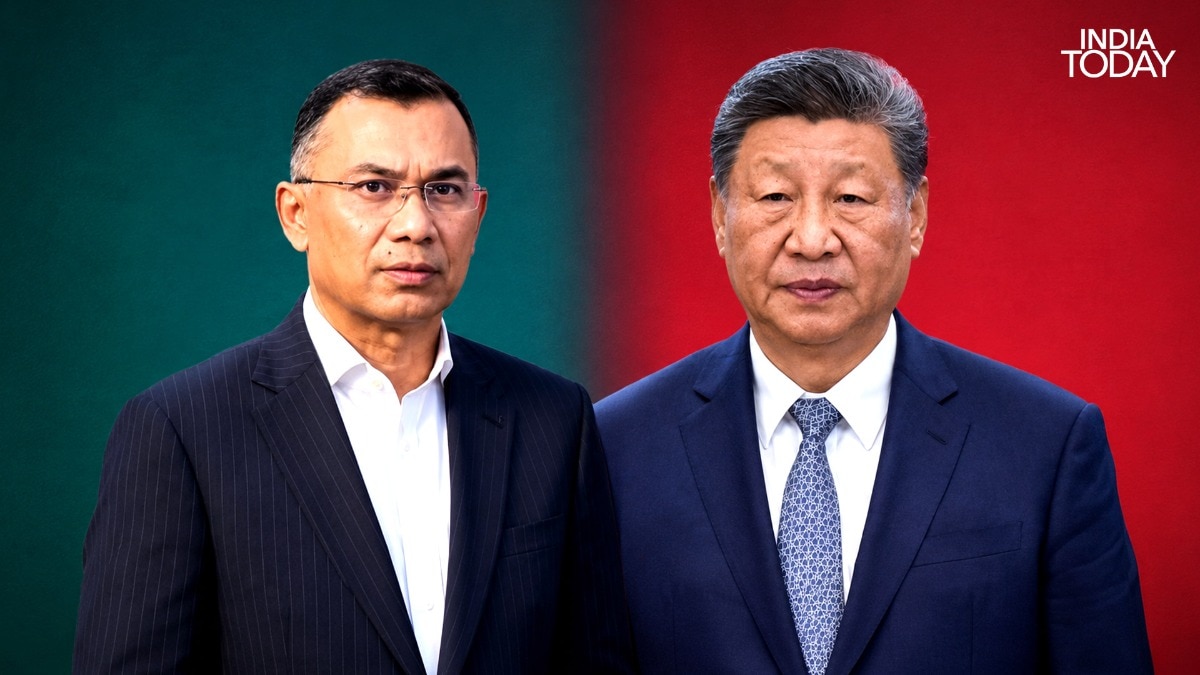
The first overseas trip of Bangladesh Prime Minister Tarique Rahman, who took over in February, could be to China, according to reports. These reports come amid efforts being made to improve India-Bangladesh relations after a turbulent phase following the ouster of former PM Sheikh Hasina, and during the interim administration led by Muhammad Yunus.
Ever since Rahman came to power earlier this year, there had been speculation over the new prime minister’s first foreign visit. Which country Rahman decided to visit first, was being closely watched by observers.
After being re-elected as Bangladesh PM in 2024, Hasina chose New Delhi for her first foreign visit, which was a strategic diplomatic move. First overseas visits by newly elected leaders are used to communicate geopolitical priorities, reassure partner nations, strengthen strategic equations and set the tone for the government’s foreign policy direction. While Hasina came to India first in 2024, back in 1996 when she became the Bangladesh PM for the first time, she visited China.
After becoming PM in 1991, former PM and Tarique Rahman’s mother, Khaleda Zia, visited the United States in 1992. Her second visit was to India for the 1992 SAARC summit. Bangladesh’s first PM, Sheikh Mujibur Rahman, visited India after being elected in 1972.
Coming back to 2026, the reports of Tarique Rahman’s potential visit to China come after cooperation between Dhaka and Beijing intensified after the Yunus-led interim regime took over. This has continued now with the BNP in power.
China has reportedly sent a proposal to Tarique Rahman inviting him to visit Beijing in late June for a state visit, Dhaka-based newspaper, Prothom Alo, reported on Monday.
However, there is no official confirmation yet from Dhaka regarding Rahman’s potential visit to China.
While the Bangladeshi government has not issued any formal statement on Rahman’s first foreign visit, remarks made by Foreign Minister Khalilur Rahaman and the Prime Minister’s Foreign Affairs Adviser Humayun Kabir on multiple occasions have hinted that Beijing could be Rahman’s first destination.
The schedule for Tarique Rahman’s proposed visit to China has not yet been finalised, according to Prothom Alo.
However, the newspaper reported that Rahman might meet Chinese President Xi Jinping and Prime Minister Li Keqiang a day after arriving in Beijing.
On May 11, when journalists asked Rahman’s Foreign Affairs Adviser, Humayun Kabir, about the PM’s first overseas visit, he said the “Prime Minister would definitely visit China”. He underlined China’s “importance as a development partner”. Kabir also said Rahman would visit China at a “convenient time”, Dhaka-based daily The Business Standard, reported earlier this month.
“Once finalised, we will let you know. At some point, the PM will visit China, which remains an important development partner for Bangladesh,” Kabir was quoted as saying.
On May 8, Chinese ambassador to Bangladesh, Yao Wen, expressed hope that Rahman’s potential visit to China would elevate relations between the two countries to new heights. Wen also assured that China would support Bangladesh in political stability and economic development. The Chinese ambassador, however, did not comment on when Rahman would visit China.
It must be noted that Bangladeshi Foreign Minister Khalilur Rahman, who was the National Security Advisor (NSA) in the Yunus regime and now serves as the Foreign Minister in Tarique Rahman’s Cabinet, visited China weeks ago in May.
He visited China at the invitation of his Chinese counterpart, Wang Yi. During the two-day state visit, Bangladesh and China held talks in Beijing and agreed to promote the Belt and Road Initiative (BRI) and “strengthen collaboration in areas including trade, investment, industry, the digital economy, water resources, health, and people-to-people connectivity,” according to Prothom Alo.
During the visit, Khalilur Rahman said that Bangladesh and China enjoy a traditional friendship, and Beijing has always been a “trustworthy” and “indispensable friend and partner” to Dhaka.
During the visit, Khalilur Rahman also reiterated Bangladesh’s support for the One-China Policy.
However, China was not the first country Khalilur Rahman visited after the BNP government took office.
The Bangladeshi Foreign Minister travelled to India in April, less than two months after the government was elected.
During his India visit, Khalilur Rahman met Foreign Minister S Jaishankar and NSA Ajit Doval.
The leaders discussed trade, energy cooperation, border management, and the “Bangladesh First” foreign policy of the new Bangaldeshi government. The visit was seen as a major step towards menting bilateral ties between India and Bangladesh.
Prime Minister Narendra Modi had also invited the Bangladeshi PM to visit India shortly after his swearing-in in February.
PM Modi had sent an invitation letter to his Bangladeshi counterpart through Lok Sabha Speaker Om Birla, who attended Rahman’s swearing-in ceremony in Dhaka.
In the letter, PM Modi expressed his eagerness to work closely with the Bangladesh Nationalist Party (BNP) leader to further strengthen the multifaceted bilateral relationship between the two countries.
While the growing closeness between Bangladesh and China is viewed by some as a strategic concern for India, New Delhi has held that Bangladesh is a crucial neighbour for regional security, connectivity to the Northeast, trade, and maintaining strategic balance in the Bay of Bengal.
China’s expanding defence and economic footprint in Bangladesh could add to New Delhi’s concerns.
However, at the same time, the Rahman-led BNP congratulated the BJP on its victory in the West Bengal Assembly elections, seeing it as an opportunity to revive talks on the Teesta water-sharing agreement.
Some frictions in bilateral ties have been reported from Dhaka over the proposed Teesta River project near the Siliguri Corridor (or the Chicken’s Neck), for which Bangladesh is seeking Chinese investments and involvement, and also the Ganga Water Treaty. Even as these points have been highlighted by Dhaka, New Delhi has also flagged issues like illegal migration and cattle smuggling to the Bangladesh foreign office. Amid these, there are efforts to bring the “all-weather” India-Bangladesh relations back on track.
Also, there is no consistency in the first foreign visits by a Bangladeshi PM. It’s pure strategic interests.
Bangladesh’s first Prime Minister, Sheikh Mujibur Rahman, visited India after being elected in 1972. Mujibur, whose daughter Sheikh Hasina also served as the PM, visited India to thank it after it helped Dhaka in getting independence from Pakistan’s rule in 1971. Mujibur Rahman specifically sought the rapid withdrawal of Indian troops from Bangladeshi soil and aimed to solidify diplomatic ties with New Delhi.
Khaleda Zia, who was elected as Bangladesh’s Prime Minister for the first time in 1991, visited the United States in 1992. She sought aid after the distress caused by the 1991 cyclone. The cyclone killed at least 1,4 lakh people and left millions homeless in Bangladesh. During the visit, Zia also met with then-US President George HW Bush to discuss the massive influx of Burmese refugees into Bangladesh. She later visited India for the SAARC summit in 1992.
Similarly, Sheikh Hasina visited China after becoming the PM in 1996. The trip was aimed at strengthening bilateral diplomatic ties and securing Chinese financial and technical support for Bangladesh’s infrastructure and economic development.
Later, when she returned to power in 2009, she went to Saudi Arabia first. During her April 2009 visit to Saudi Arabia, Sheikh Hasina met with King Abdullah, performed Umrah and visited the two Holy Mosques. She also sought increased labour opportunities for Bangladeshi workers, investment, and economic support from Riyadh. She said that she “would take initiative to convince the Saudi government to allow the stay of the expatriates’ adult children in Saudi Arabia, a major problem raised by the expatriates”, according to a report in the Voice of America.
So, Bangladesh PM’s first foreign visits have rarely followed a fixed template. While Mujibur had to seek strategic reassurance from India in 1972, Khaleda Zia turned to the US for strategic footing and aids. Hasina balanced between China, Saudi Arabia and India at different points. While Dhaka’s diplomacy has reflected the political, economic and strategic priorities of the moment, Tarique Rahman potentially choosing China first might raise eyebrows in New Delhi.
Source: India Today