

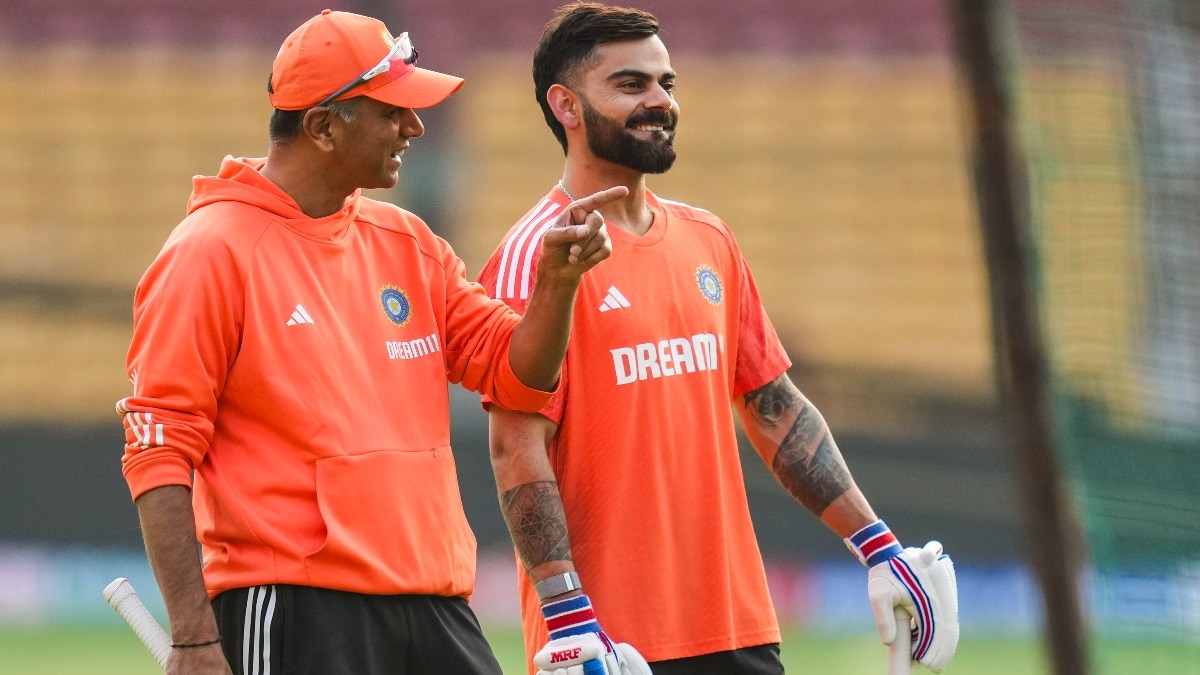
Former India captain Virat Kohli has revealed that he continued to battle “impostor syndrome” even at the peak of his career, while crediting former India head coach Rahul Dravid and batting coach Vikram Rathour for helping him recover mentally after the emotional toll of captaincy left him drained.
Speaking at the RCB Innovation Lab Indian Sports Summit Powered by Leaders in Bengaluru on Tuesday, Kohli said Dravid and Rathour “genuinely took care” of him during a difficult post-captaincy phase, allowing him to rediscover the joy of playing cricket after years of carrying the pressures of leadership across formats.
Impostor syndrome is a psychological pattern in which individuals continue to doubt their abilities and fear being exposed as not good enough despite their success and achievements. Kohli admitted that even after nearly two decades at the highest level, those insecurities still exist.
“As players, you’re always walking a very thin line between being cautious and being insecure. You constantly feel like you’re never good enough – that imposter syndrome is always there,” Kohli said.
“Even today, when I go into the nets, I still think: these youngsters are watching. If I have a bad session, they’ll probably wonder, ‘Is this the guy who’s been playing for 20 years?’ That thought is always there.”
Kohli said Dravid’s own experiences as an international cricketer helped him understand those emotions better than most. According to Kohli, both Dravid and Rathour supported him mentally during one of the toughest phases of his career.
“Rahul bhai understood that because he had experienced it himself at the highest level. Vikram had been around for years too. They understood what I was feeling and genuinely took care of me mentally. That put me in a space where I could enjoy my cricket again,” Kohli said.
The former India captain endured a rare slump in Test cricket between 2020 and 2022, going three calendar years without scoring a century in the format. The lean phase coincided with the end of his captaincy stint, with Kohli stepping down as T20I captain before leaving Test captaincy in early 2022 after also losing the ODI leadership role.
Kohli said the environment created by Dravid and Rathour motivated him to rediscover his hunger for hard work and performance.
“I’ve said this many times about Rahul bhai and Vikram Rathore. I had a great phase in Test cricket, and whenever I meet them, I thank them from the bottom of my heart because they took care of me in a way that made me feel like I wanted to play for them,” he said.
“I wanted to perform, grind it out, and do the hard work because they were so caring and nurturing. They reminded me of everything I had done so far – something you never really sit down and think about as a player.”
Kohli also spoke candidly about the emotional demands of leadership, saying captaincy often forced him to ignore his own mental wellbeing while focusing entirely on the team.
“The reason you’re given a leadership role is because people believe you can take on more and still manage it. In many ways, leadership is more about management than even coaching. It’s about understanding the people playing with you and for you, and figuring out how to get the best out of them,” he said.
“To do that, you constantly have to be in a space where you’re not focused on yourself. You don’t even think about whether someone is going to ask you, ‘Are you okay?’ That thought doesn’t even cross your mind.”
Kohli admitted that only towards the end of his leadership stint did he realise how emotionally draining the role had become.
“I did look back and realise that no one had really asked me that question for almost nine years – ‘How are you doing?’”
Despite the pressures, Kohli said he would approach leadership in the same way again if given the chance.
“When I was in the thick of things, I never really felt like I needed someone to ask me how I was doing. I was okay managing everything. And honestly, I’d do it the same way all over again,” he said.
Kohli also shared his views on workload management, saying young players should first discover the limits of their endurance before trying to slow down.
“I don’t really believe in managing workload when you’re still in the thick of your journey and trying to grow. First, you have to understand your maximum limit. Only then do you understand balance – how much you can truly take before you begin to taper it down. But if you start managing too early, you may never reach your full potential.”
Source: India Today