

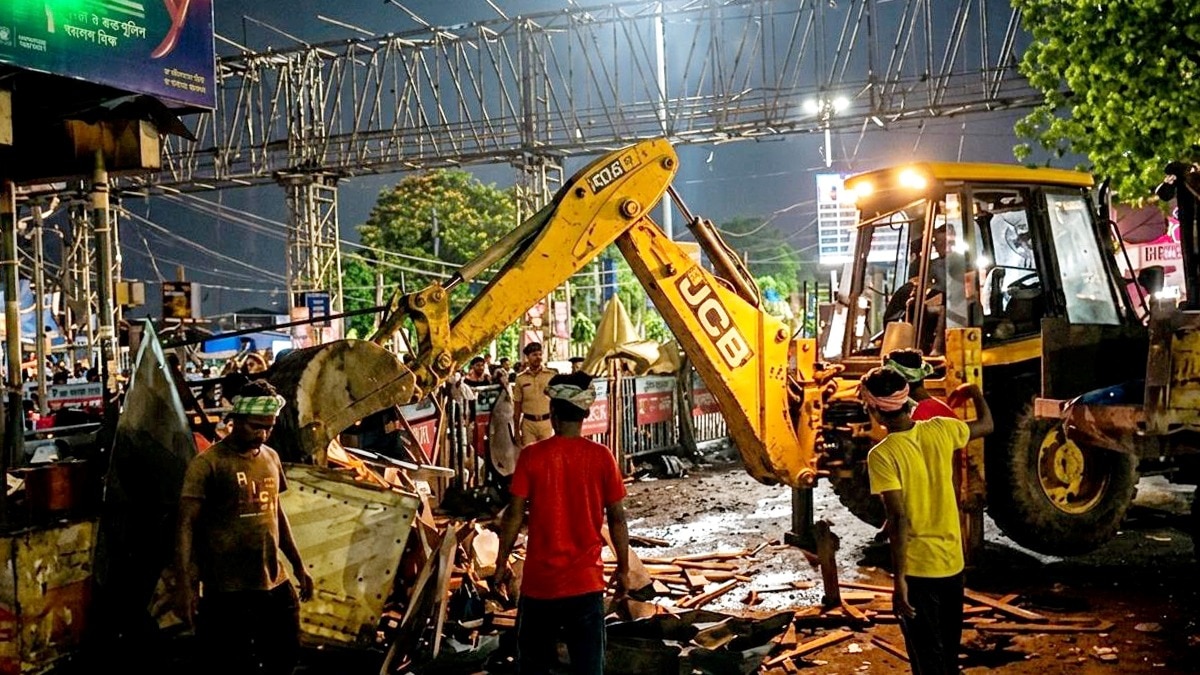
Days after coming to power, the BJP-led government of West Bengal has intensified its efforts against illegal encroachment of public places. Earthmovers have hit the streets in the state, targeting illegal structures, unauthorised hawkers and street vendors across Kolkata and the metropolitan region surrounding it. A major anti-encroachment drive took place in Howrah and Sealdah railway stations late on Saturday and ended early on Sunday.
Amid the Suvendu Adhikari-led BJP government’s anti-encroachment push, Bengal minister Dilip Ghosh said that it was only the beginning of a wider crackdown on illegal construction and encroachment across the state. He promised to run bulldozers across West Bengal.
Urging people to follow the law or face action, Ghosh, the Kharagpur Sadar MLA said, “The new government has initiated this process from day one. We will not tolerate any form of encroachment on government land”.
Encroachment has long been one of Kolkata’s most political and urban management challenges. From roadside markets and makeshift stalls to illegal extensions jutting onto pavements and roads, large parts of the city operate in a blur between formal and informal space. Alongside this, illegal construction, including unauthorised extra floors, shop extensions and buildings allegedly raised without approval have emerged as a growing civic concern. The BJP alleged that the Trinamool Congress, during its 15-year-rule in the state, had patronised them.
The scale of the issue is especially visible around Howrah Station and Sealdah stations, two of India’s biggest and busiest transport hubs.
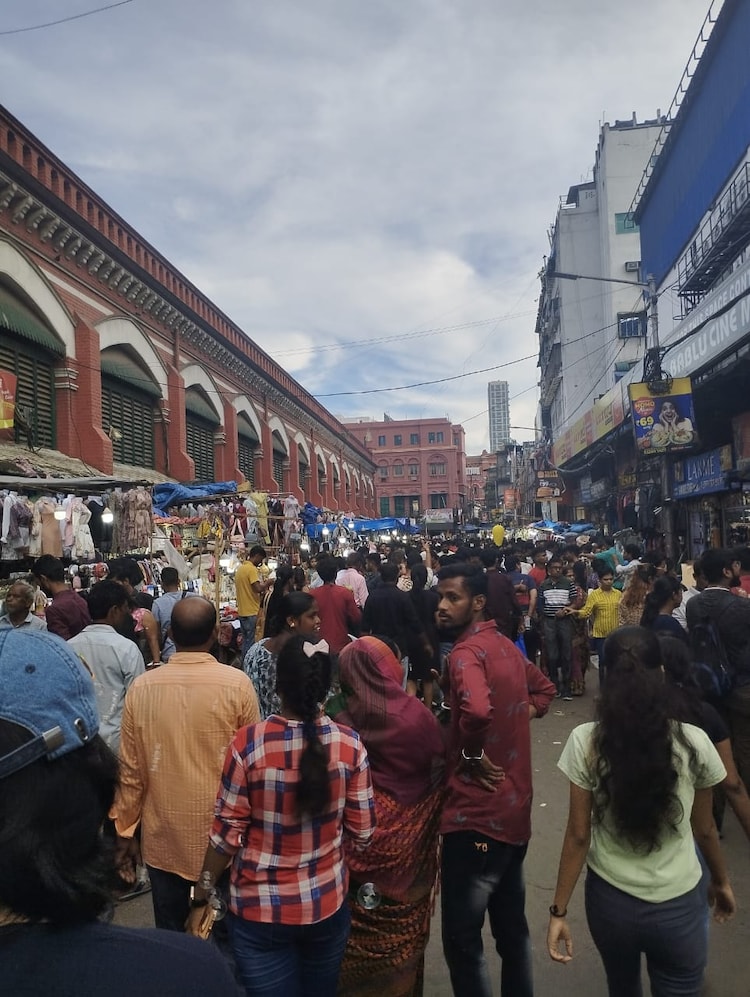
The areas surrounding both stations are lined with street vendors selling everything from tea and cigarettes to vegetables and clothes to cooked food for travellers. Many of these stalls have been operating there for years, even decades. The encroachments often choke key footpaths, forcing pedestrians onto already congested roads and contributing to traffic snarls outside the critical transit hubs.
Similar scenes play out across Kolkata in areas like Park Circus, Gariahat, Esplanade, Burrabazar and Topsia, where unauthorised commercial activity and illegal structures have steadily expanded into public spaces over decades.
Spend a few minutes parked in Kolkata’s New Market and your vehicle might quickly become part of the marketplace itself, with hawkers temporarily stacking goods on and around it to display their wares, only to clear the space once it is time for you to leave.
For years, urban planners have warned that unchecked encroachments and illegal construction worsen traffic congestion, strain ageing infrastructure and create serious safety risks. It is this vast informal network of hawkers, illegal extensions and unauthorised structures that the new BJP administration now says it intends to dismantle with bulldozers and eviction drives across Kolkata and the rest of West Bengal.
Days after taking over the reins of the state government in West Bengal, the Suvendu-led administration on May 12 conducted a demolition drive in Kolkata’s Topsia-Tiljala belt, which is a major leather goods manufacturing hub in Kolkata.
The Kolkata Municipal Corporation (KMC) had previously designated the area as a red zone for demolition alongside Garden Reach, Metiaburz, Rajabazar, Burabazar and EM Bypass. A Red Zone denotes that a specific area has a lot of illegal construction, and they are marked for demolition.
A KMC official told The Times of India that over 1,000 structures had been earmarked for demolition in Topsia-Tiljala and that at least 70% of all structures built in the last decade were illegal.
The demolition drive, where earthmovers and bulldozers moved into the area under police and CRPF protection, came a day after a fire in an illegal leather factory in a multi-story building had killed two people in Tiljala.
West Bengal CM Suvendu Adhikari ordered the KMC to raze the building while announcing a “zero-tolerance policy” against any and all illegal constructions in Kolkata.
But even as earthmovers and bulldozers moved into the area under security cover, Justice Raja Basu Chowdhury of the Kolkata High Court on Friday issued an interim stay on further demolitions in the area until June 22. Several residents of the area had petitioned the court alleging they were evicted without due notice or process.
State minister Agnimitra Paul defended the action against illegally constructed units in Topsia, stating that “If there is an illegal construction, we will send you a notice. But we will not allow you to operate if you do not have any documents to prove the legality of the structure”.
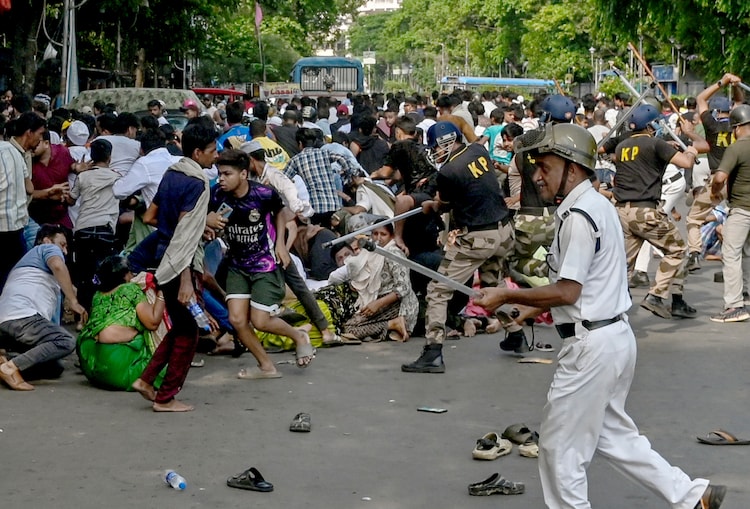
This stay, however, did little to calm tempers. On Sunday, a large crowd turned up at the Seven-Point Crossing in Park Circus to protest, among other things, the demolitions. This gathering would escalate into an all-out clash as the protestors resorted to stone pelting. At least 10 police and central forces personnel were injured and forces had to resort to lathi charge.
The Topsia-Tiljala episode was only the start.
A much larger eviction drive took place at the Howrah and Sealdah stations late on Saturday that affected at least 500 hawkers. These are among the busiest train stations in the country, handling lakhs of suburban and long-distance passengers every day.
“Not only Howrah station, but every single station in Bengal has been turned into a marketplace. It is overflowing with filth. There is absolutely no space for women, children, or adults to sit. The [Indian] Railways will reclaim its own property and utilise it to provide services to the public. To achieve this, whether it be the Railways or the Bengal Police, everyone will extend their full support,” news agency ANI reported minister Dilip Ghosh as saying on Monday.
In Howrah, a joint operation was carried out by the Railway Protection Force (RPF), Government Railway Police (GRP), railway authorities and Howrah City Police on Saturday. Bulldozers and earthmovers worked past midnight to demolish rows of makeshift shops and illegal structures along the stretch from the Ganga ghat to the Howrah station premises, reported the news agency, PTI.
Officials and local sources told PTI that the operation removed around 150 stalls and roadside shops and close to 200 hawkers from the Howrah station area. The affected establishments included vendors selling food items, fruits, toys and daily essentials.
Some vendors attempted to resist the eviction in Howrah, reported PTI. This led to heated exchanges and small physical clashes between police personnel and hawkers. Attempts to halt the drive failed in the face of heavy police deployment.
#WATCH | West Bengal | Demolition drive took place amid heavy security near Howrah Railway Station area to remove illegal encroachments (16.05) pic.twitter.com/AA1fxfDWxD— ANI (@ANI) May 17, 2026
Meanwhile, in Sealdah station, hawkers and stalls were cleared from platforms 1 to 21 of the railway station to ensure smoother passenger movement inside the terminal, officials told PTI. An estimated 250 hawkers and stalls were removed from the station premises as part of the drive in Sealdah.
The Eastern Railways last week attempted to evict slum dwellers residing around the Brace Bridge railway station in southern Kolkata. The exercise was halted by the Kolkata High Court last week after it observed that several legal questions concerning the eviction process needed further questioning.
In the aftermath of the demolition and eviction drives in and around the Howrah and Sealdah stations, several vendors turned up on Sunday to salvage what wares they could, while alleging that they did not receive adequate notice prior to the anti-encroachment drives. Several traders said many of the stalls had existed for decades and demanded rehabilitation or alternative vending arrangements from the authorities.
“We ran a fast food shop for many years. It’s now gone. No notice was issued to us before the shop was demolished,” a hawker in Howarh, who hailed from Bihar’s Darbhanga, told The Times of India.
“There should be beautification and proper management, but poor vendors should also be rehabilitated,” another vendor told PTI.
“A juice shop we had been running for 15 years was razed around 11.30 PM. We were not given any notice or warning. We have incurred huge losses. Where will we go now?” another hawker told The Times of India.
“We will have to resort to suicide if no rehabilitation is provided,” another stall owner affected by the drive, told PTI.
While the Trinamool Congress has slammed the BJP over the drives, these are the questions the new Suvendu Adhikari-led BJP administration in West Bengal will have to confront as it prepares to roll bulldozers across the state. Illegal encroachments and unauthorised constructions have plagued Kolkata and large parts of Bengal for decades. And the BJP government is acting to get cities and towns to get rid of them.
Source: India Today