


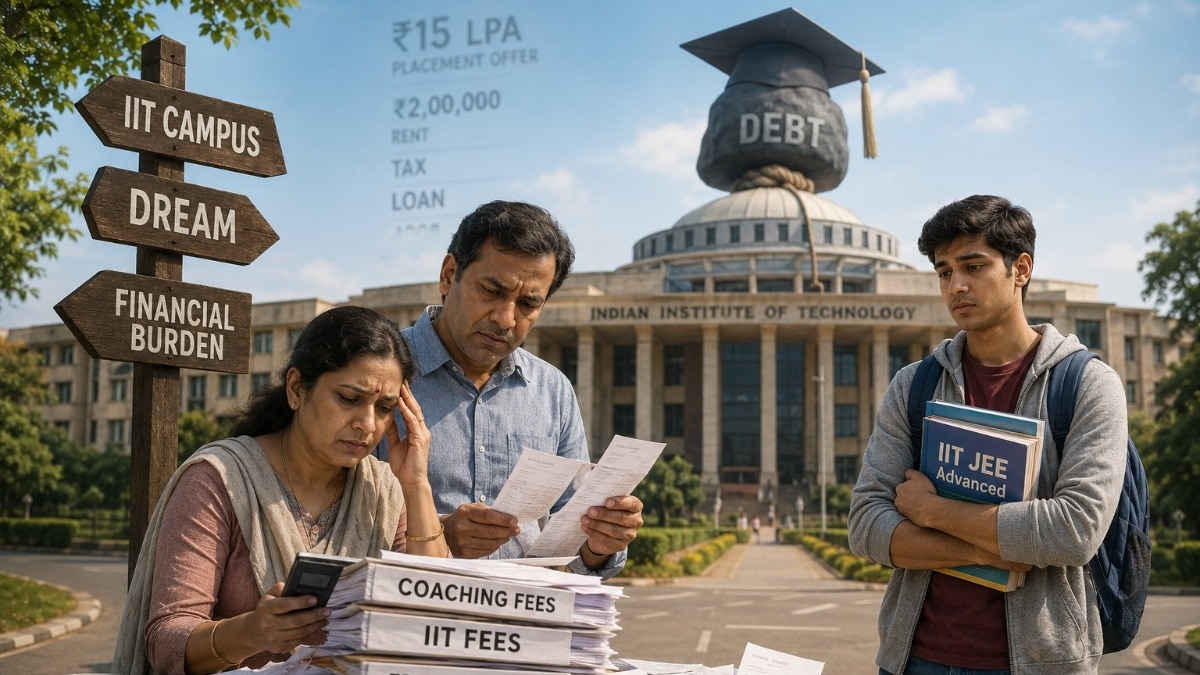
The numbers are in, and they should worry every parent who is writing cheques for JEE coaching. I have spent years telling students and their parents that cracking the IIT is worth the sacrifice, the sleepless nights, the pressure-cooker prep, all of it justified by the promise of life-changing placements.
But that promise is slowly starting to look hollow.
The latest IIT Bombay data reveals a stark reality. IIT Bombay, arguably the crown jewel of the IIT system, just released its placement numbers for 2024-25, and they paint a troubling picture. The hiring rate has dropped compared to last year, fewer companies showed up, and average placement percentages are not anything to go to town with.
At first glance, some of the numbers appear reassuring. At 70%, this is lower than the institute’s last year’s placement rate of 75%, but the average annual salary has increased to Rs 26.45 lakh and the median salary reached Rs 20 lakh.
The institute has noted that both figures rose by over 10% compared to the previous year, indicating stronger compensation trends despite global uncertainties in the hiring market.
But we have seen how averages and medians can hide uncomfortable realities. A handful of ultra-high international packages and AI-driven hiring spikes can sharply pull up averages even when a significant number of students are settling for modest offers or still searching for jobs months after graduation.
For middle-class families spending nearly two decades preparing a child for this moment, the real question is no longer whether salaries are rising, but whether they are rising enough to justify the cost, pressure and financial risk involved.
Many people have also commented on X, saying if in 2025 the average is Rs 26 lakh, it is very soon going to slip into the Rs 15 lakh bracket… as early as 2027!
Next year average salary will drop to 15lpa, and placement will drop further more.
A tsunami is coming, if you dont have 50lakh+ savings or a govt job, then go into survival mode right now. https://t.co/PWx2gP8Kd2— Aditya (@303extreme) May 20, 2026
And this is happening at IIT Bombay, the institute that typically leads placement statistics. If the flagship is struggling, what does that say about the rest of the system?
Here’s a realistic breakdown of what an IIT seat costs a middle-class Indian family.
For reserved category students, the tuition fee is lower. But for general category families, often paying full fees without any scholarships, this is the reality.
This is the uncomfortable truth about “average” placements. As reported earlier, industry insiders and placement coordinators are now suggesting that the true average placement offer across IITs may settle around Rs 15 LPA in the next year or so.
Not the median of the top 50%. Not the headline-grabbing Rs 2 crore international packages, but the actual average that most students can realistically expect.
This is what changes the entire ROI equation.
A student whose family spent upwards of Rs 20 lakh on their education is now looking at a starting salary that could take nearly two years of gross income just to break even, before taxes, before rent, before living expenses, before EMIs on education loans.
The uncomfortable truth is that even a Rs 26 lakh median package does not automatically translate into financial comfort in cities like Bengaluru, Mumbai or Hyderabad. Once taxes, relocation expenses, rent and loan repayments kick in, the take-home value shrinks rapidly.
If the broader IIT ecosystem starts drifting closer to a Rs 15 lakh average package, the return-on-investment debate becomes impossible to avoid.
“When average offers hover near Rs 15 lakh (which it will soon), the return on a Rs 18–25 lakh total investment is marginal at best for many families,” says Prof Radha Menon, a Bengaluru-based higher education policy scholar.
She points out that for many middle-class households, the IIT journey is funded through years of savings, loans or even retirement money, with the expectation that the degree will fundamentally transform a family’s financial future.
Dr. Nidhi Gupta, a former Dean (Placements) at a public technical university in Chennai, believes the old placement logic itself is changing. “The brand premium is shrinking; skills now trump badges. Without robust hiring, the IIT price tag no longer guarantees commensurate outcomes any way,” she tells India Today.in.
According to her, recruiters today are increasingly rewarding practical skills, adaptability and project experience over institutional pedigree alone.
Here’s what we’re not talking about honestly. A tier-2 engineering college graduate with the same coding skills, entering the same job market, often lands packages between Rs 8–12 LPA. The gap between that and a Rs 15 LPA IIT offer is roughly Rs 3–7 lakh annually.
At that differential, it could take anywhere between three and five years just to recover the additional investment made in IIT preparation and fees.
And that assumes the IIT graduate does not take a drop year, does not burn out mentally under years of pressure, does not miss out on earning opportunities while peers at NITs, IIITs or state colleges are already interning or working.
The explanations are already lined up… “It’s a global slowdown,” say some. “Tech hiring is weak everywhere,” a few others feel. Then there is a section that tells us reassuringly, “The market will recover eventually.”
All of that may be true.
But there is a larger problem. Families are rarely told this when they sign up for Rs 6 lakh coaching packages for one year in Kota, Hyderabad or Delhi. The coaching industry still sells the dream of guaranteed prosperity. The IIT brand is still marketed as a near-foolproof ticket to upward mobility.
Even when IIT Bombay is seeing hiring slowdowns and reduced placement rates, we have a systemic honesty problem.
This is not an argument against IITs. The education quality, alumni network, peer ecosystem and long-term career trajectory still matter immensely. But families also need to acknowledge that NITs, IIITs and top state engineering colleges often deliver 70–80% of the career outcome at a fraction of the cost.
The fee for an engineering degree at IIITs is up to Rs 5 lakh, while the NITs will charge somewhere between Rs 4–5 lakh for a four year degree course.
Skills-based hiring is increasingly making institute tags less important than what students can actually build, code, design or solve. Meanwhile, the coaching industry’s incentives are not aligned with a family’s financial wellbeing. Coaching centres profit whether a student ultimately lands the dream placement or not.
If your family is about to spend Rs 20 lakh chasing the IIT dream, you deserve to know the real numbers, not just the cherry-picked Rs 2 crore packages that dominate headlines, but the Rs 15 LPA offers that most graduates are far more likely to receive.
The question is no longer whether IIT is prestigious. Of course, it is. The real question is whether that prestige is still worth mortgaging a family’s financial stability when the returns are beginning to shrink.
Increasingly, the answer is… “it depends.”
SSSHHH… This is not something that the coaching industry wants you to hear.
Source: India Today